Archive for July 2013
a Brown(e) question…
A commenter, Ellen, has alluded to one of those frustrating conundrums that drive us all nuts trying to figure out. She referenced Sally’s site here:
http://www.sallysfamilyplace.com/MulberryGrove/browne2.htm
Another site I highly recommend is by Helen Sharpe… she mentions this John Brown deed and connects the Elizabeth Brown to a John Joyner (son of Bridgeman Joyner). She has done a remarkable job sifting out the numerous Joyners.
http://wc.rootsweb.ancestry.com/cgi-bin/igm.cgi?op=GET&db=sharpefamily&id=I3329
And I too have with struggled with that befuddling deed… who the heck was that John Brown?
Mary Best Bell, Colonial Bertie County, NC, DB A-H, 1720-1757
Bell, C 167(160) Susanah Brown, John Warren & wife Grace, Sylvester Brown and ____ to Elizabeth Joyner
Feb. 12, 1727/28. *. 256 A. “…love… for our sister Elizabeth Joyner…” Land formerly belonging to our father, John Brown dec’d. Patent July 28, 1713. On WS Chowan adj. J. Curlee, J. Smith. Wit: Fincher Hayne, Charles Brown. Court *. Thomas Crew D. C/C.
Sally and her friend have attempted to tie the deed to one John Brown, son of Edward Brown of Isle of Wight. I respectfully disagree… or not so much disagree as simply offer another theory…
Some thoughts on the deed itself… It does not say WHEN John Brown died; just that he was “deceased”. The deed is dated 1727/28, so John Brown could have lived until just prior to 1727. My theory is that a John Brown(e) of Kingsale, 1639-1713? was the original owner of the property mentioned in the deed. I think he had a son named John, also, who could be the father of the descendants mentioned in the deed. The land may have simply devolved from father to son. The major problem with the theory is that neither man left a death record. Dontcha just hate that. (smiling) My attempt at proving the theory is frustrating because all the key players are phantoms in the records. But John Sr and his son? are in the records enough to provide some tantalizing “circumstantial” evidence.
I think I have identified WHERE the property was… roughly. That would be on or near Wiccacon Creek and the Chowan River. I have a map here with some detailed notes…
I am convinced, and I think beyond a reasonable doubt, that the John Brown I chronicle on the map page above is the Indian Trader from Kingsale. Of course, the money question is whether or not he is the John Brown mentioned in the 1727 deed above? I think he is and the later John is his son. Below are some notes from my “Page” on Brown… It is difficult to follow even for me (and I wrote the damn thing).
Pay attention to the neighbors… particularly the James Curley and John Smith mentioned in the 1727 deed above. Most of these guys were cronies and Indian Traders. Most gave testimonies in 1707 and in 1710 concerning the boundary dispute between VA and NC at the time.
——————————————
1713…John Browne died intestate?
Not finding a plausible will for John Browne in IOW, Grimes or elsewhere, I assume he died intestate. A possible event is succinctly noted by Hathaway: ” John Browne dead. April 7, 1713.”, p. 34, Vol. 1, The North Carolina historical and genealogical register. This note was in his listing of wills prior to 1760 and gives no context but hints of a possible record somewhere, perhaps a court record.
Now I’m a bit frustrated…I have the Hofmann book in front of me which “should” have the Court Minutes of 1713 of which Hathaway quotes freely for much of his work (written 1900 if I remember correctly). Unfortunately the Hofmann abstracts are missing the 1713 section… it has 1711 and begins anew at 1714. DARNIT! either this section is misplaced or missing. Hathaway also mentions that he quoted from the Secretary of State records but the NC Archives online does not mention a Brown will of 1713 that I can find.
A bit more speculation…
Thomas Joyner, Jr and Bridgeman Joyner each signed the petition for the pardon of William West in 1677 after Bacon’s Rebellion. Whether or not they participated is open to debate. John Rogers Sr was found guilty of carrying away property belonging to Mr. Robert Caufield “during the late horrid rebellion”, (Order Bk. 1671-90, p. 165), and on the same date John Rogers, Sr. was found guilty of seizing Arthur Allen’s house, etc. (p. 167, Boddie). All these “horrid” accounts are written from the “winners” perspective of course… the “rebels” point of view would have been different I am sure. This John Rogers appears to relocate from Surry County to Nansemond. John Rogers (Sr or Jr?) is purported to marry Mary, the sister of Richard Booth who devises property to Rogers in 1681. All of these gents are of the same generation. Thomas Joyner Jr. and Bridgeman Joyner settle near the Kingsale Swamp area of IOW. Another neighbor, Thomas Mann married Elizabeth, another sister of Richard Booth. Also nearby, in Kingsale, is John Browne. In 1690 Hodges Councell, “the younger” and Thomas Man Jr. patent 200 acres “beg. at a marked gum John Brown’s corner tree in Kingsale swamp”. All of these folks were “confederates” if you will… J.B. Boddie, in one of his Historical Southern Families volumes, attempts to connect this Brown with Bridgett Williams… I disagree.
Other researchers have attempted to tie John Joyner, son of Bridgeman Joyner, to a 2nd marriage to one Eizabeth Brown. I suggest that if there is a connection of an Elizabeth Brown she may have been a daughter of John Browne. Bridgeman Joyner and John Browne lived very near each other in the area of Kingsale Swamp… this easily sets the stage for their children to meet and wed. This John Browne relocates to North Carolina about 1700 near Wiccacon Creek, along with Richard Booth and Booth’s nephew Thomas Mann, Jr. With that being said, I have to further speculate that the Elizabeth Browne who marries John Joyner may need to be the daughter of John Browne Jr… and hence, the granddaughter of John Browne the Indian Trader. Yeah, I know I’m tap dancing… but remember the deed has to be reconciled for all this to work… This deed shows that John Joyner died around 1749 so it appears that Elizabeth Brown could well be the “granddaughter”… simply from an age point of view. (John Browne Sr. dies 1713…Junior dies by 1727… daughter Elizabeth carries on to 1740s.)
IOW WB 5-187: John Joyner: Estate appraised by Henry Dawson, Joshua Dawson, James Turner. Signed Absalom Joyner R. 1 June 1749.
Feb. 12, 1727/28. *. 256 A. “…love… for our sister Elizabeth Joyner…” Land formerly belonging to our father, John Brown dec’d. Patent July 28, 1713. On WS Chowan adj. J. Curlee, J. Smith. Wit: Fincher Hayne, Charles Brown. Court *. Thomas Crew D. C/C.
This account by Boddie gets my attention… well actually it just confuses the hell out of me… or it is another John Brown that is muddying the water?
Historical Southern Families Vol. 1
Pg. 23 John Brown died in Surry Co. 1714, wife Eliza Brown 6-6-1714 left 1 son and 4 daughters as follows:
1. Sylvester Brantley Bertie Co. NC (is this a typo?… is this a step-son?… is this a female?)
2 Hester Brantley, the will of Hester probated in 1727 in Surry Co. VA mentioned her daughters Priscilla and Elizabeth and her 2 sisters Eliza Joyner and Grace Warren. Appoints James Wilson and James Piland executors.
3 Eliza married to Nehemiah Joyner (is this an Elizabeth Brown different from the one I am researching?… if so this can get VERY confusing!))
4 Grace married John Warren of Bertie Co. NC
5 Susannah Brown
There is a missing link here… I’m wondering if it may be a son John Jr that left this will in Surry County? Or not?
—————-
That account has caused speculation of a JOYNER connection to these deeds in North Carolina in 1727…
Mary Best Bell, Colonial Bertie County, NC, DB A-H, 1720-1757
Bell, C 167(160) Susanah Brown, John Warren & wife Grace, Sylvester Brown and ____ to Elizabeth Joyner
Feb. 12, 1727/28. *. 256 A. “…love… for our sister Elizabeth Joyner…” Land formerly belonging to our father, John Brown dec’d. Patent July 28, 1713. On WS Chowan adj. J. Curlee, J. Smith. Wit: Fincher Hayne, Charles Brown. Court *. Thomas Crew D. C/C.
(I note that this does not state that their father died in 1713… it merely says the patent is dated 1713)
C 171 Susanna Brown & Sylvester Brown to William Evans Nov 22, 1729. 5 pds for 100 A. On Horse swamp. Adj. John Thomas, Lazarus Thomas. Wit: Richard Williford, Mary Luden (Laden?). Feb Court 1729. Thomas Crew D. C/C.
and again in 1741…
F 344 Soloman Joyner of Edgecombe Co., & John Joyner & wife Elizabeth of Isle of Wight Co, Va. to Joseph Witherington of Surry Co, Va. Feb 7, 1741. 25 pds, for 256 A. A Patent granted John Brown for 256 A. July 28, 1713 on “Bank of the River” adj. James Curlee, John Smyth Wit: James Washington, Henry Crafford, Morning Crafford, John Sherard, William Plyant, John Fort (FOORT). May Court 1742. Thomas Crew C/C.
So the Elizabeth Joyner who received the Brown property by gift in 1727 was the wife of John Joyner… (of Isle of Wight in 1741). And this is apparently the rationale that this Elizabeth was a “Brown”. The property passed from Brown to Brown descendants since 1727… it seems logical.
all of which relates to this patent…
Margaret Hoffman, PROVINCE OF NORTH CAROLINA ABSTRACTS OF LAND PATENTS 1663-1729
3313 pg. 285 John Brown date (not given) 256 acres on the W. side of Chowan River, joining the bank of ye river, James Courlee, and John Smith Witnesses: (not given)
The half dozen patents before and after that one are in the date range of 1713-1716… so logic dictates that the date of July 28, 1713 is probably correct and was referenced in the later deeds… my problem with this is a “death” reference for “a” John Brown in 1713 (Hathawy).
” John Browne dead. April 7, 1713.”, p. 34, Vol. 1, The North Carolina historical and genealogical register. If this is the same guy then the patent may have been issued after his death OR it was perhaps re-issued to a son of the same name. My theory is that it was devised to a John Brown Junior. And this is the John Brown that died sometime before 1727 and was the father of the Brown children who gifted the property to their sister Elizabeth who married John Joyner of Isle of Wight.
Now I haven’t exactly pulled this John Brown Junior out of thin air… I do have some proof:
3 Jun 1690…. John Browne, the Elder, to Richard Shewll…. 100 acres (being part of 600 acres) on Broadneck Swamp adjoining Wolf Pit Branch.
Wit: Edward (X) Floid, Henry Baker and Thomas (X) Wickins.
2 Dec 1692…. John Browne, Sr. appoints John Browne as his attorney in the difference with Capt. Hugh Campbell.
Wit: Daniel Leigh and Mary (X) Browne
Consider this deed of Susanna Brown & Sylvester Brown again from 1729… mention of Lazaris Thomas… note where he and they seem to be living:
C 171 Susanna Brown & Sylvester Brown to William Evans Nov 22, 1729. 5 pds for 100 A. On Horse swamp. Adj. John Thomas, Lazarus Thomas. Wit: Richard Williford, Mary Luden (Laden?). Feb Court 1729. Thomas Crew D. C/C. (How, pray tell did Sylvester Brantley of Boddie’s account above become this Sylvester BROWN?… my head hurts).
JAMES PEEK to JOHN WARREN, Aug 9 1727, 10 pds for 100 a. SS Chowan River, adj. LAURANCE MARTIN,LAZARUS THOMAS at Horse Swampe. Wit: John Beverley, John Sutton. November Court 1729, (Bertie Co Deed Book C p181)
JOHN EARLY to DAVID RYAN, heir of THOMAS RYAN, deceased. 1754, 350 a.. for discharge of a bond from John Early to Thomas Ryan land between JAMES WILKON’s line and the Holley Swamp at Horse Swamp” adj. ISAAC LEWIS, JAMES WILLIAMSON, LAZARUS THOMAS, WILLIAM WARREN to the Wiccacon Swamp. Wit: John Cricket, Thomas Kinsey, John Nichols Jr. Aug Court 1754 (Bertie Co Deed Book H p111)
Note that John Warren was in the 1727 deed with Susanna Brown and Sylvester Brown gifting the property to Elizabeth Joyner…
BK B PG. 112
1715 – Elinor Merrett/Meriet to William Nixon/Mixon (melton) 16 Apr 1715 p of atty to act in open Court 130 A for ye said William Merret unto James Peeke. Witnesses: Peter Evens, Rich Barfield.
Ellinor Merritt to Wm. Mixon. Power of Attorney to acknowledge deed to Rich’d Barefield for land sold by my husband Charles Merritt and Peter Evans to said Barefield, 280 acres on Deep Creek branch, Test. Wm. Mixon, Peter Evans.
Same to acknowledge deed to James Peake, of Boston, Executed by my husband Charles Merritt for 130 acres on south side of Chowan River, at ye mouth of Deep Branch; Apl. 16, 1715. Test, Peter Evans, Richard Barefield (NCHGR 138).
…from will of James Peake 1728…
“Item my will is that my executors hereafter mentioned do grant & give to
John Warren of the precinct a good and lawfull deed for one hundred acres of
land that he now lives on he paying at his ens__ling the said deed Tenn
pounds currant mony of North Carolina not withstanding not withstanding
(sic) any thing that is before mentioned to the contrary.”
Charles Merrit was an old croney Indian Trader with John Brown and Richard Booth.
——————————–
The whole perplexing account is here…
A few liars…
A commenter, Rogers Smith, and I have been corresponding the last couple of months and hashing out theories on his ancestor John Rogers. I have a theory that Rogers was an Indian Trader. To make the point that he was a Trader also may explain how he met his wife.
Firstly, we know that his wife was the sister of Richard Booth who was a known Indian Trader. Such is stated in a deed of 1681:
Apr 20, 1680, Richard Booth obtained a patent of 560 acres of land in Isle of Wight County on Corowaugh Swamp (W.D. 1,pp.473; DB 1, pp 53-54). Nov 8, 1681 he assigned his interest in this land to Thomas mann and his wife Elizabeth with John Rogers and Charles Mann as witnesses (DB1, p.473) On that same day Richard Booth sold to his sister’s husband, John Rogers, 100 acres on Beaver dam Swamp; and on the next day, Nov 9, 1681 he gave 100 acres adjacent to his sister Mary Rogers (Ibid, p.463) [Boddie, Southside Virginia families]… Boddie purports Thomas Mann married another sister of Booth, i.e., Elizabeth Booth.
The problem is that John Rogers was living at this time in Surry County, VA. The four abstracts below help explain the circumstances of him moving from Surry County to Isle of Wight County:
Surry County records, 1652-1684, Eliz. T. Davis
Page 302. 6 March 1681. Jno. Rogers, Sr., empowers his friend Elias Osborne his lawful attorney., Robert lee, John Vincent.
Surry County records, Eliz. T. Davis
Page 328. 9 Feb. 1682/3 Mary Rogers, wife of Jno. Rogers, makes Edward Baly her atty. in right of dower to sell to Edward Grantham. John Due, Rich. Lucas.
Surry County Records, 1652-1684- Eliza Timberlake Davis
Page 318. 7 9ber 1682. John Rogers, Sr., appoints his wife. Mary Rogers ye elder, his lawful attorney to collect his debts etc. Josiah Hacume?, John Rogers, Younger. Jno. Rogers, Jr., – made oath to same.
Surry Co., Va., Deeds & Wills 1671-1684, p. 307, May 2, 1682,
deposition of John Young, aged 36, that he took Robert Lea and his wife,
and John Rogers’ wife and child to Lynnhaven, they intending to go Southward.
Circumstantially, it would appear to be Mary Rogers, the sister of Richard Booth but the one abstract above mentions “Mary Rogers ye elder” which opens some doubt I cannot resolve… this suggests there were two Mary Rogers. And as yet we have not identified the name of John Rogers’ son by the same name and the name of his wife.
But back to my theory that Mary (Booth) Rogers was his wife. How would he have met her? He living in Surry, she in Isle of Wight near the Nansemond line.
Some history of Richard Booth…a 1707 deposition concerning the boundary dispute between VA and NC…
Edwd Moseley
North Carolina ss.
Before me Edward Moseley Esqr one of the members of the Council and being Authorized to take the Depositions of Certain persons relateing to the boundarys of this Government, personally Came and appeared Richd Booth aged sixty three years or thereabouts who on his Oath on the Holy Evangelists taken saith that in or about the year 1661 this Deponent came into Virginia and served Major Merritt six years (who then lived about Twenty miles from the Weyanoake Indian Town the Weyanoks living very near a plantation that now belongs to Collo Harrison betwixt Blackwater River & Weyanoake River which Weyanoake River by reason of the Declension of the Weyanoake Indians and the Nottoway Indians removing nigher to it has since in this Deponents memory gained the name of Nottoway River by the Virginians) And this Deponent further saith that in the year 1667 he being employed by one William West to go in a Canoe with Certain goods &c to the Maherine Indian Towns one Jno Browne and a certain Weyanoake Indian called Tom Frusman being in the Canoe with him as they went down Blackwater River this Deponent then being a Stranger in those parts any other than by hearesay enquired what river that was they first mett with on
their Right Hand they answered it was Weyanoake and Opposite to the Rivers mouth was a field belonging to the Weyanoakes it being then about one of the Clock in the afternoon this Deponent enquired how far it was to Maherine River they answered they should gett there before sun down which they did accordingly whereby this Deponent Computed it was about thirteen miles by Water and this Deponent further saith that he never understood that the Weyanoake Indians ever lived to the Southward of that River
RICHd BOOTH.
Capt et Jurat Decimo die January Anno 1707 Coram me
Edward Mosely
Of course the Virginia hotshots in 1707 would consider that a bald-faced lie. Well, the bit about the Nottoway River being called the Weyanoake River anyway… That little tidbit was what the fuss was all about. North Carolina insisted the boundary was the Nottoway River as it is today (they won the dispute). Virginia insisted the bounday was some miles south.
The lies are what I find fascinating in this squabble. Lies and Scoundrels… It is difficult for me to find the truth or the truth tellers.
So… Richard Booth came to the Kingsale Swamp area of IOW/Nansemond in 1661. In 1667 he was working for William West and canoed past the mouth of Nottoway River and headed down to trade with the Meherrin Indians. But who was the “Major” Merritt that he says he “served” six years?
Keep in mind that the Virginia depositions were conducted by Philip Ludwell and Nathanial Harrison, Jr. Below is the deposition of Benjamin Harrison (of Virginia).
DEPOSITION OF BENJAMIN HARRISON IN REGARD TO INDIAN AFFAIRS, 1707.
Benjamin Harrison, Esq., aged sixty-three years, or there- abouts, being sworn, saith:
That to the best of his remembrance in the year one thousand six hundred and sixty three in the month of September, the Waynoak Indians sent in to the Governor and informed him that their king was killed by the Pohick Indians, whereupon a party of men were imediately sent out, who brought in the Queen and severall other Waynoak Indians; and in a few days after, another party of men were sent out of which this deponent was one, the Queen and her Indians went back with them, and they found the rest of the Waynoak Indians by the side of a great Swamp to the Westward of Nottoway River sheltered with a peace of a puncheon fort; about five or six miles from their Town; which was then called Wariecoke, standing near the banke along the South side of Nottoway River, to which place the English and some Indians went to gather corne for theire Journey in, and then they went back to the beforementioned swamp, and brought all the Waynoak Indians (they could find) in amongst the English; where to the best of this deponents re- membrancethey stayed about two yeares; and then, the English being uneasy at the Indians hunting upon their lands, the Indians went out again, as this Deponent was informed (and verily believes) to the Southward of Meheren River but to what particular place he does not know, they continued out (as well as this Deponent remembers) about two yeares; and then the Tuscarora Indians and they having some difference, the Waynoaks came in to Meheren River where (as they said) the Tuscarora’ fell upon them; and then they sent again to the Governor, who sent another party of men out to them, of which this Deponent was one; they found the Indians in an old field called Unotee very near the banke of Mehern River on the North side of it, sheltered with an half moon made with puncheons, and they brought them in a second time amongst the English. In these Expeditions the Deponent Crossed Nottoway River four times, one night they Quartered very near it; and in all the Discourse that this Deponent had or heard about it, it was always called Nottoway River (and by no other name) both by the English and Indians, and whilst the Indians stayed amongst the English they had some Cabbins in the Deponents orchard, where he had severall Discourses with them, and he does verily believe that if ever Nottoway River had been called by any other name he should have heard something of it from them, but he never did. The second time the Waynoak Indians came in they stayed amongst the English about a yeare or more and then they settled upon the South side of the Black Water Swamp, at a place now called the old town, where they staved about seven or eight years, and then they removed about four miles down the Swamp on the same side, which was their last Settlement, very near the place where this Deponent now hath a Plantation; upon which Charles Merrit was overseer, who went thither about the year I69I or I692, and continued there about five years and then he removed to some land belonging to the Colledge, where as this Deponent was informed, he stole severall of his hoggs, and upon this being known, the sense of his guilt (as the Deponent verily believes) made the said Charles Merrit runaway into North Carolina, and since that time this Deponent hath been severall times told by the Nottaway and Meheren Indians that the said Merrit has desired them to speake to him (this Deponent) that he may have leave to come back again into Virginia, which he was desirous to do if he might he out of fear of being prosecuted for the said hoggstealing. This Deponent further saith that he hath been concerned in the Indian trade both with the English and Indians for about five and thirty years passt or more; and hath many times had Discourseabout MeherrinRiver, Nottoway River, and Blackwater, and he never heard them called by any other name than what they go by at this day. He believes he may have severall times have heard the name Waynoak River or Creek but never knew where it was, till of late the Inhabitants of North Carolinamaking encroachmentsupon the Queens land (as this Deponent apprehended). He made inquiry about it of the Nottaway, Meheren, and Nansemond (or Pochiack) Indians and they all said that after they left Mapacre they Waynoaks went to the Southward of Meheren River and setled in a fork between the two great swamps which are the head Branches of a small River that empties itself into Chowan, and that (they say) is Waynoak River, and that they neither knew or ever heard of any other Waynoak River but that.
And this Deponent furthersaith, that about five and twenty years ago, the Tuscaroro Indians fell upon the Waynoaks, at thelr last settlement upon Blackwater Swamp; and the Nottoway Indians were said to join with the Tuscaroras: Whereupon the Queen of the Waynoaks complained to the Deponent of the wrong the Nottoways did them, for that the Waynoaks had paid them a yearly acknowledgement for their liberty of living at Warueake (upon Nottoway River) as long as they lived there, and afterwardsthey paid them for the liberty of living upon the Blackwater, and of late, this Deponent enquiring (about it) of the Nottoways, they confirmed the truth of the Waynoaks hav- ing paid them an acknowledgement, till the Articles of Peace were made with the English; and then they looked upon them- selves to have no further right to any land than those articles do give them, so they did not receive the Acknowledgement any longer. And further this Deponent saith not.
BENJA: HARRISON.
Novemb I5, 1707. Sworn to before us,
N. Harrison,Jun’, Ffran: Mallory.
Colonial Letters, &c., The Virginia Magazine of History and Biography , Vol. 5, No. 1 (Jul., 1897), pp. 42-53
Mr. Benjamin Harrison, Esquire, seems to have a personal dislike of Charles Merritt. But then even if Charles Merritt was a hog stealer what in hell does that have to do with the name of the Nottoway River? Nothing that I can see. It seems to me more like a calculated attempt to discredit any testimony of Merritt. Ahh… the intrigue.
Let’s see what the hog stealer had to say:
North Carolina ss.
Before me Edward Mosely Esqr one of the members of the Council and Authorised to take the Depositions of certain persons relateing to the boundarys of this Government Personally Came and appeared Charles Merritt aged fifty five years or thereabouts, Who on his Oath on the Holy Evangelists taken saith that he Came into Virginia in or about the year 1666. And lived about twenty yeares on the south side James River and then lived on A Plantation of Collo Benjamin Harrisson on Blackwater and within call of the Weyanoake Indian Forte and consumed there five yeares during which time this Deponent had frequent Discourses with the Indians and was by them informed that they never Claimed to the Southward of the Maherine River But at the time that the Appachoukanough was Routed and taken for the Massacre he had committed the Weyanoakes (being his Confederates and fearing the English) removed themselves from that place which is now called Weyanoake in James River to Warraekeeks on Weyanoake River and after when the Poackyacks killed their King they were by the English brought from thence and placed on the Blackwater aforementioned as Tributarys. where this Deponent lived by them and this Deponent further saith that he was informed by the Weyanoaks that the Weyanoke River now Called Nottoway was their bounds and that they never Seated to the Southward of Warr-a-keeks
the mark of
CHARLES P MERRITT.
Capt at Jurat Duodecimo die Jany Anno Domi 1707 Coram me
Edwd Moseley
That testimony seems to be free from any pork that I can see. But lets run some numbers…
According to Merritt he arrived in VA in 1666. (records show him in Surry County)… He says after 20 years (1686) he moved to Benj. Harrison’s plantation on Blackwater and resided there 5 years (making the date 1691).
Interestingly enough, the Surry tithables show Charles Merritt on the roles in 1689…
1689 Benja: Harrison, Charles Merritt, Jno: Rivers, Silas Smith, Tho: Haynes, Richd: Bullock, Jno: Morgan, 14 Negroes, one Indian – 22
1691 Benja: Harrison Senr, Ben: Harrison junr, Tho: Haynes, Silas Smith, Charles Merritt, Jno. Morgan, fifteen negroes, one Indian, 22
1692 Charles Merritt, 1
1693 Cha: Merritt, 1
1694 Charles Merritt, 1
* list per Benja: Harrison (why did not Mr. Harrison prosecute Merritt?)
1695 Charles Merritt, 1
1696 Cha: Meritt & Fra. West, 2
1697 Charles Meriott, 1
For some reason it appears Mr. Benjamin Harrison, Esquire, lied in his testimony of when Charles Merritt worked for him as an overseer. (If I read it correctly, Harrison has Merritt working for him from 1691 to 1696) Or perhaps he just had a memory lapse such as it also appears Mr. Harrison “forgot” to claim Mr. Merritt as a tithe from 1686 to 1688 (note that Mr. Merritt was diligent to claim himself after he left Harrison in 1691). Or… in my opinion, he was just a pompous ass who lied about the name of the Nottoway River and slandered Mr. Merritt in an attempt to find favor with his son/nephew/whatever Nathaniel Harrison and the odious Philip Ludwell.
But back to Richard Booth’s deposition… he says he “served Major Merritt six years (who then lived about Twenty miles from the Weyanoake Indian Town the Weyanoks living very near a plantation that now belongs to Collo Harrison betwixt Blackwater River & Weyanoake River”
If you believe Charles Merritt’s testimony (and it is substantiated by the Tithables) then he worked for Harrison from 1686-1691. That is the period when Booth was evidently trading for Benjamin Harrison’s enterprise. Harrison stated in his deposition he was a Trader for 35 years… ” This Deponent further saith that he hath been concerned in the Indian trade both with the English and Indians for about five and thirty years passt or more;”
Since Richard Booth demonstrably stayed in the area of Kingsale Swamp it stands to reason that John Rogers was the one who traveled south from Surry County and met Booth’s sister and married her. I suspect that he was also involved in the Indian Trade perhaps in association with Booth (who basically grubstaked him some land in 1681).
The speculation on John Rogers being a trader is theory buy it offers an avenue to search for more clues…
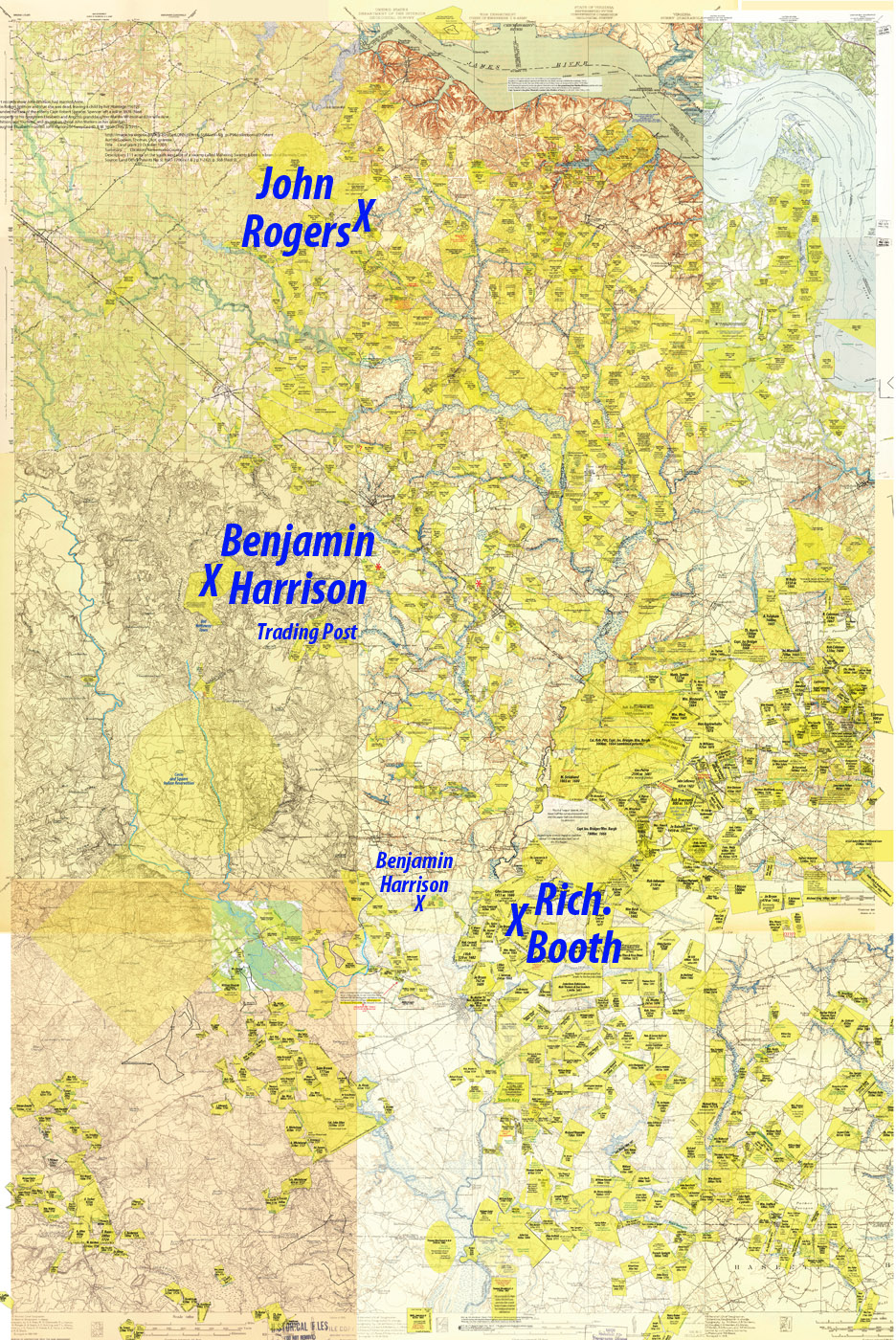
Here is a reference map… Benjamin Harrison had numerous patents in different places (most of which I have not researched)… the one near the “Circle and Square” Indian reservations is interesting because of the depositions referencing the various Indian tribes. I see no reason to doubt Mr. Harrison’s testimony on the historical facts… but I think you have to read between the lines to sort out the truth from his lies… The basis of the boundary dispute was that Virginia insisted the line should be drawn from Wiccacon Creek in NC and not the Nottoway River. They persisted in claiming the Weyanoake Indians lived on Wiccacon Creek. Harrison himself contradicts that assumption…consider the actual testimony of Harrison: [in 1663] “they found the rest of the Waynoak Indians by the side of a great Swamp to the Westward of Nottoway River sheltered with a peace of a puncheon fort; about five or six miles from their Town; which was then called Wariecoke, standing near the banke along the South side of Nottoway River…”. Just look on my map to see where the moron was referring:
The detailed map is here:

memo to Holmes…
Sir:
Regarding the case of Daniel McDaniel… I have followed a few leads in Surry County and found a rather incriminating reference to our man in the will of one Lawrence Fleming in 1710. Apparently this McDaniel fellow was indebted to Mr. Fleming but found favor with the dying man since he forgave the debt if the son of McDaniel was “schooled” as it were. As you no doubt surmise, this puts our man McDaniel in the awkward position of being married before we picked up his trail in North Carolina. Since I find no property attributed to our man, I can only assume that he was of the “working” class… ahem. The sordid notes are in my Page for McDaniel which I have diligently updated. How and when he arrived in Virginia is still a mystery.
As to his criminal involvement in the death of the good Reverend Ebernezer Taylor, Clerk, “dec̄ed”, I am still at an embarassing loss to find any hard proof that it was “our” man and not another fellow with the same name as Daniel McDaniel. It seems that another McDaniel had taken up residence in Carteret Precinct in 1723 and left a record in a list of Jurymen. The notorious Rob’t Atkins also left his footprints in said County. I find it suspicious that our man was furiously wheeling and dealing property between 1717 and about 1722… I cannot ascertain where he was living and find it rather frustrating as he seems to have several involvements with different properties. However it opens the possibility still that he is our culprit and may simply have spent a short time in Carteret County. A sly move on his part as it establishes an alibi if such be the case.
Again, as you no doubt surmise, since he had a wife (possibly) and a known son in 1710, his age may have been perhaps 25 (a guess, forgive me)… Alas the poor woman MUST have met her demise before 1715 as the cad remarried a mere child of 15 or 16 years! Scandalous! Proof of this nefarious marriage is found in a deed in my notes.
The poor child, not knowing any better obviously, stayed with McDaniel until his death in 1733. Which begins another mystery of one John Anderson who seems to marry the befuddled widow sometime after her widowhood and obviously partaking of his rather sizeable estate, I might add. The ONLY clue and lead I have at this point is a rather unremarkable reference to a man of his name as a “headright” in 1683. Forsooth Holmes! I need more evidence!
as always, your faithful servant, etc, etc…
Postscript
A CLUE Holmes!
I just uncovered evidence of the suspect, dare I say rogue Robert Atkins! (I leave it to you to ascertain whether he was indeed a mutherer, of course). The noted detective, Bob Baird, detailed some interesting court documents in his own investigations. Vis…
0 Feb 1711/2 Special Bail: In the suit of Richard Rogers vs. Daniel MackDaniel, the plaintiff demanded special bail whereupon Richard Blow became the defendant’s bail, and judgment granted plaintiff for 50 shillings. [Surry County Orders 1691-1713, p389]
”Special bail” was a relatively uncommon occurrence. It meant that, if the defendant failed to pay, the special bail would pay on his behalf – or, in the extreme case, would serve his time in debtor’s prison. Richard Blow’s relationship with Daniel McDaniel must have been a reasonably close one to undertake this action.
Note, Holmes, that we are not the only ones who are suspicious of this McDaniel fellow… Mr Baird evidently also has his eye on him. And with good reason I might add. One Robert Atkins was also lurking in the shadows at about this time and place…
18 Jul 1718 Robt. Atkins appointed overseer of the highways from Richard Blow’s through the main Blackwater Swamp by Joseph Wall’s. [Surry County Orders 1713-1718, p148]
Is this proof Holmes? Is this sufficient evidence for an indictment? I leave it for you to decide.
… again, your humble servant, etc, etc….
Holmes (in reply):
Nice try Dear fellow… but no cigar. The Robert Atkins you mention stayed in Virginia while our suspect was simultaneously dealing his dirty deeds in North Carolina. Unless he had a son by the same name then your efforts were for naught. Have a Scotch… Rethink… and perhaps move your investigation to North Carolina.
Holmes
My notes as usual can be found in my Pages… Daniel McDaniel, Sarah McDaniel and John Anderson….