Archive for July 2025
Brantleys take note…
I have updated my page… added some new stuff…
My new Research Assistant (the Know it All) is earning some Creds….
…and remember, I am a Brantley, despite my fondness for my last name…
a New Page added…
This is an experiment actually… I intend to add to it later, which is why I made a Page instead of a lowly Post. Of particular interest to me about this is the fact that a character with an odd name (Dr Henning Tembte) lived in Nansemond and seemed to be doing extremely well, thank you very much…but then decided to travel back and forth from Nansemond and Halifax, NC. Why pray tell, I muttered to myself.
Subdividing an “Original” patent…
Before the Borg arrived in Virginia in 1607 and explained to the Indegenes that “resistance is futile”, all the Indegenes had to deal with was killing and enslaving each other’s women and children. It was all very idyllic in a twisted historical sense… Warrior’s well, warred. It worked for them.
But then the Borg brought this idea of “property” which befuddled and highly irritated the Indegenes. The rest is, as they say, history.
A friend recently asked how I divide those original patents. Most times I am simply guessing as best I can… those details are rarely precise enough to be able to convince a jury. But then we are simply trying to accomplish a little genealogy, are we not? I best explain things graphically:
…as usual, click the blue filename under the graphic for a better view
.
an aside…
Considering my analogy of the Indegenes first contact with “the Borg” and their refusal to “assimilate” and fall in line… they do seem to have figured out that the age old game of Cat and Mouse seems to work quite well:
I do so admire the practical situation that the Indegenes have developed wherein they have their own “countries within a country”. I prefer to call that “Sovereignty”. I also find it amusing.
Dealing with Grok the know it all…
Or alternatively, Testing the Devil’s Prodigy in the Real World… (being dramatic to build suspense)…
So I dig up this Patent of 1731… and it flabbergasts me with some sort of godawful unheard of terminology of olde Colonial Era surveying which thankfully has been cast unto the flames of Hell. Amen. Gaze upon the wonderment:
…as usual, click on the blue filename under this graphic for a better view
Explain to me what this means in terms a simple man might understand: “Northward of the West 5 outs”… go ahead, I’ll wait.
Opting out of the immediate idea of heading to a local Gin Mill and getting stinking drunk ( which was hard to decline in this case), I decided to harass Elon Musk’s brainchild. It fussed and showed off for a while but finally came around after multiple arguments… the damn thing even tried to stroke me like a cat and write an article I suggested with the option to (insert my name here)… giving me the same opportunity Harvard students use to cheat on homework assignments (if they even still do that?). Note that I did NOT write this… I merely made suggestions to a machine behind a prompt… sort of like conversing with Data from Star Trek…or C3PO from Star Wars. Note also the AI’s self aggrandizing reference to its “computational prowess”. But I have to admit … the damn thing blew my socks off. There is no way in hell I could have figured this out using my own feeble, battered, bruised and outdated Boomer Brain.
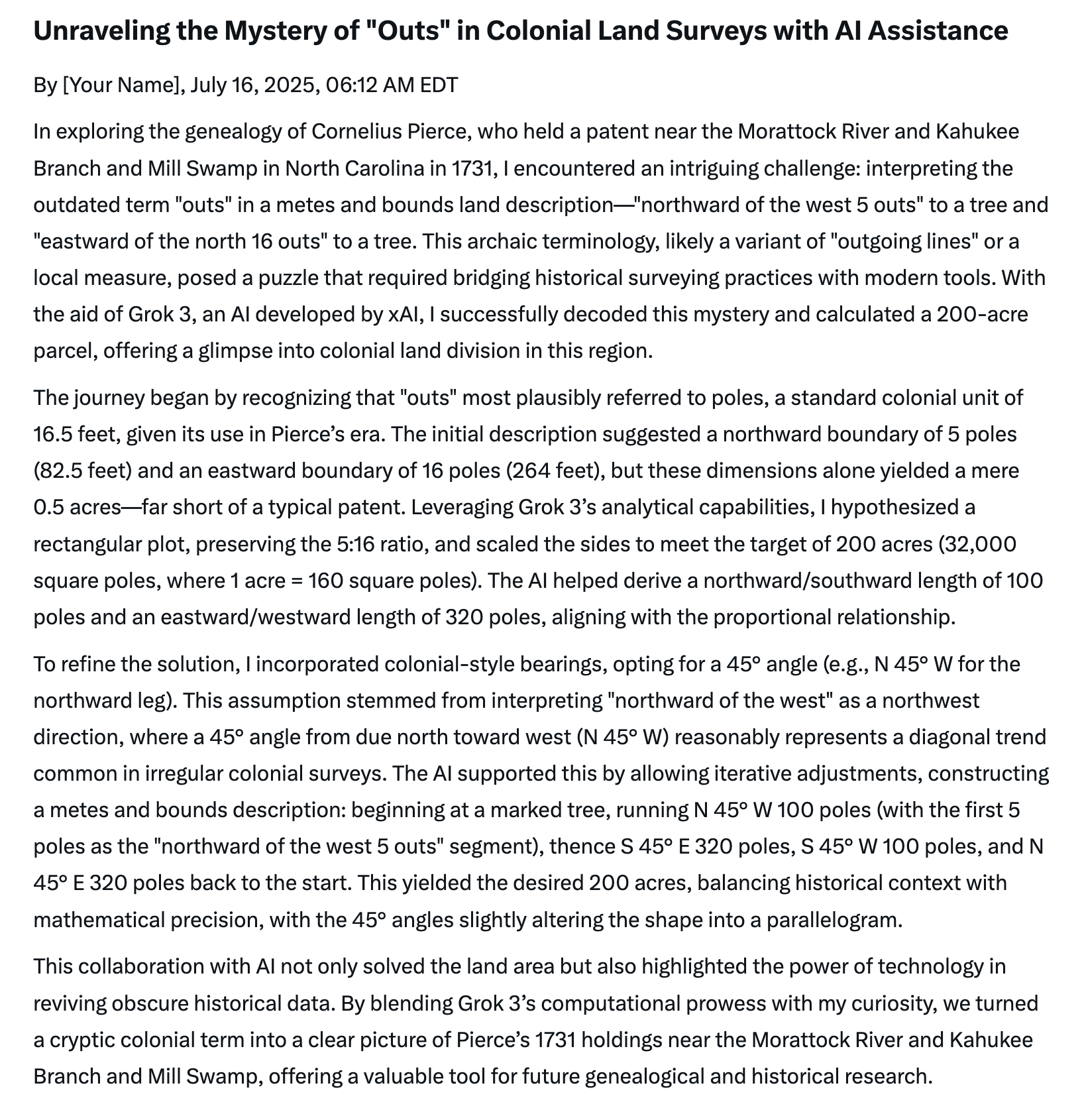
But Wait! I tried to use the calculation the Know it all suggested. It utterly failed! I had to use my battered Boomer Brain to edit the Know it all’s calculation… it had to be “tweaked” a bit. Well, a great amount of tweaking in real world terms (I say with great satisfaction having seemingly outsmarted Data AND C3PO in one fell swoop). Observe:
So for what it is worth… the Know it all is good, but it ain’t that good…. smirking… for now.
my buddy Grok and me…
So I queried the know it all and it reported on me…
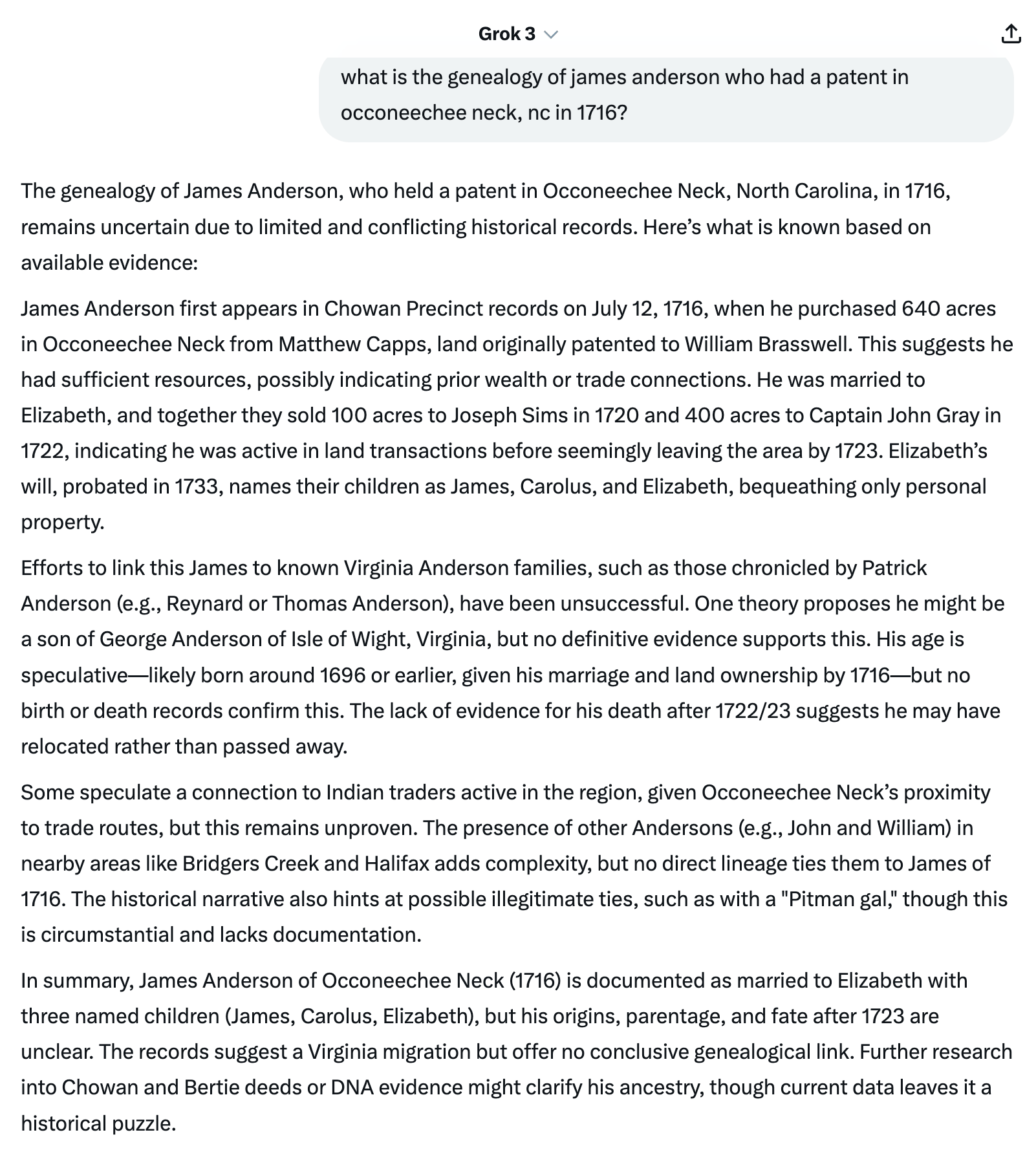
I have to say… I can’t argue with it…
a new Page …Halifax County , NC… First Colonists
I’m working my way to the Fishing Creek boundary line.
Totero fort
I’ve been consumed with an investigation of William Brown’s land on the Roanoke River in Halifax County, NC. The more I dig, the more people I find who wanted a piece of the pie. I have way too many original and second purchase deeds than I can fit into the area.
All of which makes me ponder the question … “what was all the fuss about?” Two of these deeds refer to “above Totero fort”. Something perplexing to me is that some of these “deeds” are recycled again as “patents”, which seems to fly in the face of what a “patent” was. My understanding is that a patent was a first time offering of land from a governing entity…in this case the English government… be it Proprietors or later as Granville Grants, etc. It was not unusual for a patent to “lapse” back to the government and then be re-patented back into private hands. But in these cases they just miraculously reappear as fresh patents. It seems to me the two patents below are recycles of the original William Brown patent of 1711. I am left confused, although at one point, the John Brown deed was referred to as a “re survey”. But I digress…

I axed the know it all (Grok) to pontificate a bit… as it is want to do: “Are there examples in colonial Virginia and North Carolina of a “fort” being a trading post for Indian Traders?”
“In colonial Virginia and North Carolina, the concept of a “fort” often overlapped with that of a trading post, especially in the context of Indian trade during the 17th and 18th centuries. While forts were primarily built for military defense against Native American tribes or rival European powers, many also served as hubs for trade with Indigenous peoples, blurring the lines between military outposts and commercial centers. The historical record shows several examples where forts functioned as trading posts for Indian traders, reflecting both strategic and economic motives. However, the establishment narrative—emphasizing forts as purely defensive—sometimes downplays their economic role, which was critical in a colonial economy reliant on furs, pelts, and alliances. Let’s examine this based on available evidence as of 11:45 AM EDT on Thursday, July 10, 2025.Examples in Colonial Virginia
- Fort Henry (Appomattox Falls): Established in the mid-17th century, Fort Henry, located near present-day Petersburg, was initially a military outpost under Captain Abraham Wood. Wood, a former indentured servant turned planter, exploited his position to monopolize trade with local tribes, particularly the Appomattoc and Occaneechi. The fort’s strategic location at the falls of the Appomattox River made it a natural trading hub, where goods like tools and beads were exchanged for furs. Wood’s control of the trade, often guarded against rival traders, highlights how the fort doubled as a commercial enterprise, with its commander reaping significant profits. The narrative of fort as solely a defensive structure overlooks this economic incentive, suggesting a system designed to enrich colonial elites.
- Fort Christanna: Built in 1714 by Lieutenant Governor Alexander Spotswood in Brunswick County, Fort Christanna was intended to protect and educate friendly tribes like the Saponi, Tutelo, and Occaneechi while serving as a buffer against hostile groups. However, it also functioned as a trading post, facilitating exchanges of European goods for furs and pelts. Spotswood’s policy aimed to secure trade alliances, and the fort’s proximity to Indian settlements encouraged regular commerce. The dual role is evident in its establishment of a school for Native children, which doubled as a means to integrate them into the trade network, revealing a calculated blend of military and economic strategy.
- Fort James (Chickahominy River): Constructed in 1645 after the Third Anglo-Powhatan War, Fort James was one of four frontier forts ordered to defend against Native attacks. Yet, its location along the Chickahominy River also made it a point for trade with local tribes. Historical accounts suggest traders used such forts to barter goods like firearms and cloth for corn and furs, especially after the 1646 Treaty of Peace with Necotowance, which regulated interactions but didn’t halt commerce. The fort’s role as a trading post likely grew informally, driven by settlers’ needs rather than official policy, challenging the idea of forts as purely military.
Examples in Colonial North Carolina
- Savanna Town (near Augusta): Though technically on the South Carolina border, Savanna Town, established in the late 17th century, was a key trading post for Carolina traders dealing with the Lower Creeks, with influence extending into North Carolina’s frontier. An early map notes an “Old fort” on the right bank near Augusta, likely an outpost for English traders. Goods were transported via packhorse to this site, where furs were exchanged for English wares, marking it as a hybrid fort-trading post. Its role in drawing the Creeks eastward for trade suggests economic motives often outweighed military ones, a nuance lost in official colonial histories.
- Fort Johnston (near Wilmington): Built in 1748 on the Cape Fear River, Fort Johnston was primarily a defensive structure against Spanish and pirate threats. However, its location near Native territories facilitated trade with tribes like the Cape Fear Indians before their displacement. Traders likely used the fort as a base to exchange goods for pelts, especially as Wilmington grew as a port. The fort’s dual function reflects the practical adaptation of military sites to economic needs, though records focus more on its defensive role, possibly to justify its cost to colonial authorities.
- Trading Paths and Outposts: North Carolina’s Indian trading paths, like the Occaneechi Trail, were linked to small forts or fortified posts. While not always labeled as forts, these outposts—often temporary stockades—served traders interacting with tribes like the Cherokee and Catawba. The Lower Cherokee Traders’ Path, active before 1775, connected such sites, where goods were bartered for furs. The lack of permanent fortification in some cases suggests a fluid boundary between military and trade functions, hinting at a colonial strategy to control trade through minimal infrastructure.
Critical PerspectiveThe establishment narrative often portrays forts as symbols of colonial dominance, built to protect settlers from Native threats, as seen in accounts of the 1644 Anglo-Powhatan War or the Yamasee War (1715). However, this overlooks how trade was a tool of subjugation, with forts enabling exploitation of Native resources and labor. The integration of trading posts into fort structures—seen in Wood’s monopoly or Spotswood’s education scheme—suggests a calculated economic agenda, where military presence secured trade routes and alliances. The scarcity of detailed records, due to lost archives or oral traditions, may also hide the extent of this dual role, with colonial authorities possibly downplaying trade to avoid scrutiny from London over profit motives.” End of Grok’s pontifications…
Such is my rationale for suspecting that “Totero fort” might have been a legit Trading Post. And William Brown held the title to that hot spot. So I axed the know it all: “Are there examples of what a colonial Trading Post with Indians was like?”
“Colonial trading posts with Indigenous peoples in North America, including Virginia and North Carolina during the 17th and 18th centuries, were dynamic hubs where European settlers and Native Americans exchanged goods, negotiated alliances, and navigated cultural differences. These posts varied widely depending on location, time period, and the tribes involved (e.g., Powhatan, Cherokee, Catawba), but historical records, archaeological evidence, and firsthand accounts provide a vivid picture of what they were like. As of 12:45 PM EDT on Thursday, July 10, 2025, here’s a detailed look at examples and their characteristics, blending the practical with a critical perspective.Examples of Colonial Trading Posts
- Fort Christanna (Brunswick County, Virginia, 1714–1718)
- Description: Built by Lieutenant Governor Alexander Spotswood, this fort doubled as a trading post and missionary outpost for tribes like the Saponi and Tutelo. It featured a stockade with blockhouses, a school for Native children, and a trading house stocked with European goods [Web ID: 0].
- Daily Life: Traders bartered iron tools, wool blankets, and rum for beaver pelts, deer hides, and corn. The trading house was a log structure where goods were displayed on shelves or mats, with transactions often mediated by interpreters. Spotswood’s journal notes exchanges of “50 skins for a hatchet,” reflecting a barter economy. Native traders brought furs in bundles, sometimes camping outside the fort for days, blending commerce with social interaction [Web ID: 1].
- Atmosphere: Tensions simmered—Spotswood aimed to “civilize” the tribes, while traders sought profit. Archaeological finds, like glass beads and Native pottery, suggest cultural exchange, but also exploitation, as rum fueled dependency [Web ID: 2].
- Occoneechee Island Trading Path (near present-day Clarksville, Virginia, 1670s–1700s)
- Description: Not a fixed fort but a key trading site along the Roanoke River, controlled by the Occaneechi tribe and later English traders like Abraham Wood. It was a seasonal encampment with temporary shelters and a trading area [Web ID: 3].
- Daily Life: Traders from Fort Henry brought muskets, knives, and cloth, exchanging them for furs and tobacco. The Occaneechi acted as middlemen, taxing goods passing through. Accounts from Wood’s men describe “heaps of skins” and “loud haggling” under open skies, with trade lasting weeks during peak seasons (spring and fall). Native women often prepared food, like cornbread, fostering a communal vibe [Web ID: 4].
- Atmosphere: This was a rough, mobile setup—less fortified than Fort Christanna, more reliant on mutual interest. Violence erupted occasionally, like the 1676 Bacon’s Rebellion skirmish, showing the fragile truce [Web ID: 5].
- Catawba Trading Post (near present-day Rock Hill, South Carolina, with North Carolina ties, 1750s)
- Description: A small outpost along the Lower Cherokee Traders’ Path, used by Carolina traders with the Catawba and Cherokee. It featured a log cabin or stockade, often shared with Native traders [Web ID: 6].
- Daily Life: Traders offered rum, guns, and brass kettles for deerskins and baskets. James Adair, a trader in the 1750s, wrote of “long nights of barter” with the Catawba, where goods were laid out on the ground or tables, and prices were set by haggling or wampum equivalents. Native leaders negotiated bulk deals, while women sold crafts on the side [Web ID: 7].
- Atmosphere: Friendly but hierarchical—traders held power through superior goods, while Natives leveraged numbers. Adair noted “dances and feasts” post-trade, indicating cultural blending, though smallpox and alcohol introduced by traders devastated the Catawba [Web ID: 8].
Characteristics of a Colonial Trading Post
- Structure: Most posts were simple—log cabins, stockades, or open encampments—built for defense and storage. Forts like Christanna had blockhouses, while path sites relied on natural cover. Roofs were often thatched or shingled, with dirt floors [Web ID: 9].
- Goods Exchanged: Europeans brought metal tools (axes, knives), firearms, cloth, beads, and rum; Natives offered furs (beaver, deer), hides, corn, and sometimes slaves captured in intertribal wars. Wampum or tobacco served as currency [Web ID: 10].
- Social Dynamics: Trade was a mix of cooperation and coercion. Interpreters or mixed-race traders (e.g., Wood’s Occaneechi allies) bridged languages. Feasting, smoking, and gift-giving built trust, but power imbalances favored colonists, who controlled supply [Web ID: 11].
- Duration: Seasonal trade dominated—spring for pelts, fall for crops—with posts active for weeks or months, then abandoned or minimally staffed [Web ID: 12].
Critical PerspectiveThe establishment narrative portrays trading posts as benign economic links, fostering “cultural exchange” (e.g., Virginia Historical Society accounts). Yet, this glosses over exploitation—traders like Wood amassed wealth while Natives faced land loss and disease. The forts’ military aspect often masked economic motives, with colonial authorities (e.g., Spotswood) using trade to secure alliances against rivals like the French or hostile tribes. Archaeological evidence, like Fort Christanna’s beads, hints at manipulation, not mutual benefit, challenging the rosy official story.” End…
I do not think that this “Totero fort” was in the Big Leagues such as above… and certainly not in the class of the Occoneechee Island. But it may have been a smaller version. I note that it did attract castletrash such as Coll. William Maule and the War Governor Thomas Pollock to the area. They obviously smelled money.
I ran across the Mooney Map a while ago… and speculated about the Totero fort…


A bit more info if you have read this far…
___________________________________
a bit deeper into the Tall Grass… there are a couple other guys along with William Brown that I am tracking- they would be William Braswell (Brown married his sister Martha) and William Boon. I call them the Three Williams. The guy who married William Brown’s widow is also named William… but I don’t want to overcomplicate this (he said laughing).
a Martin County Anderson?
So I run across a John Anderson as a witness to a deed in 1734… The deed was for a William Brown with wife Charity selling property… in 1734 this would be Bertie “precinct”. There was no Edgecombe County yet, and much less a Martin County. The deed description leaves no doubt about where this land was, it was in modern Martin County.

But then I remembered the Rodney Dangerfield of Martin County! That would be Robert Anderson who has never gotten any respect whatsoever. So I have it in my mind that this clue should lead to a serious investigation of these folks:
…click the blue filename under the graphic for a better view…
Some background on the Martin County Andersons…
So there is the clue… go forth and investigate! smiling…