A few liars…
A commenter, Rogers Smith, and I have been corresponding the last couple of months and hashing out theories on his ancestor John Rogers. I have a theory that Rogers was an Indian Trader. To make the point that he was a Trader also may explain how he met his wife.
Firstly, we know that his wife was the sister of Richard Booth who was a known Indian Trader. Such is stated in a deed of 1681:
Apr 20, 1680, Richard Booth obtained a patent of 560 acres of land in Isle of Wight County on Corowaugh Swamp (W.D. 1,pp.473; DB 1, pp 53-54). Nov 8, 1681 he assigned his interest in this land to Thomas mann and his wife Elizabeth with John Rogers and Charles Mann as witnesses (DB1, p.473) On that same day Richard Booth sold to his sister’s husband, John Rogers, 100 acres on Beaver dam Swamp; and on the next day, Nov 9, 1681 he gave 100 acres adjacent to his sister Mary Rogers (Ibid, p.463) [Boddie, Southside Virginia families]… Boddie purports Thomas Mann married another sister of Booth, i.e., Elizabeth Booth.
The problem is that John Rogers was living at this time in Surry County, VA. The four abstracts below help explain the circumstances of him moving from Surry County to Isle of Wight County:
Surry County records, 1652-1684, Eliz. T. Davis
Page 302. 6 March 1681. Jno. Rogers, Sr., empowers his friend Elias Osborne his lawful attorney., Robert lee, John Vincent.
Surry County records, Eliz. T. Davis
Page 328. 9 Feb. 1682/3 Mary Rogers, wife of Jno. Rogers, makes Edward Baly her atty. in right of dower to sell to Edward Grantham. John Due, Rich. Lucas.
Surry County Records, 1652-1684- Eliza Timberlake Davis
Page 318. 7 9ber 1682. John Rogers, Sr., appoints his wife. Mary Rogers ye elder, his lawful attorney to collect his debts etc. Josiah Hacume?, John Rogers, Younger. Jno. Rogers, Jr., – made oath to same.
Surry Co., Va., Deeds & Wills 1671-1684, p. 307, May 2, 1682,
deposition of John Young, aged 36, that he took Robert Lea and his wife,
and John Rogers’ wife and child to Lynnhaven, they intending to go Southward.
Circumstantially, it would appear to be Mary Rogers, the sister of Richard Booth but the one abstract above mentions “Mary Rogers ye elder” which opens some doubt I cannot resolve… this suggests there were two Mary Rogers. And as yet we have not identified the name of John Rogers’ son by the same name and the name of his wife.
But back to my theory that Mary (Booth) Rogers was his wife. How would he have met her? He living in Surry, she in Isle of Wight near the Nansemond line.
Some history of Richard Booth…a 1707 deposition concerning the boundary dispute between VA and NC…
Edwd Moseley
North Carolina ss.
Before me Edward Moseley Esqr one of the members of the Council and being Authorized to take the Depositions of Certain persons relateing to the boundarys of this Government, personally Came and appeared Richd Booth aged sixty three years or thereabouts who on his Oath on the Holy Evangelists taken saith that in or about the year 1661 this Deponent came into Virginia and served Major Merritt six years (who then lived about Twenty miles from the Weyanoake Indian Town the Weyanoks living very near a plantation that now belongs to Collo Harrison betwixt Blackwater River & Weyanoake River which Weyanoake River by reason of the Declension of the Weyanoake Indians and the Nottoway Indians removing nigher to it has since in this Deponents memory gained the name of Nottoway River by the Virginians) And this Deponent further saith that in the year 1667 he being employed by one William West to go in a Canoe with Certain goods &c to the Maherine Indian Towns one Jno Browne and a certain Weyanoake Indian called Tom Frusman being in the Canoe with him as they went down Blackwater River this Deponent then being a Stranger in those parts any other than by hearesay enquired what river that was they first mett with on
their Right Hand they answered it was Weyanoake and Opposite to the Rivers mouth was a field belonging to the Weyanoakes it being then about one of the Clock in the afternoon this Deponent enquired how far it was to Maherine River they answered they should gett there before sun down which they did accordingly whereby this Deponent Computed it was about thirteen miles by Water and this Deponent further saith that he never understood that the Weyanoake Indians ever lived to the Southward of that River
RICHd BOOTH.
Capt et Jurat Decimo die January Anno 1707 Coram me
Edward Mosely
Of course the Virginia hotshots in 1707 would consider that a bald-faced lie. Well, the bit about the Nottoway River being called the Weyanoake River anyway… That little tidbit was what the fuss was all about. North Carolina insisted the boundary was the Nottoway River as it is today (they won the dispute). Virginia insisted the bounday was some miles south.
The lies are what I find fascinating in this squabble. Lies and Scoundrels… It is difficult for me to find the truth or the truth tellers.
So… Richard Booth came to the Kingsale Swamp area of IOW/Nansemond in 1661. In 1667 he was working for William West and canoed past the mouth of Nottoway River and headed down to trade with the Meherrin Indians. But who was the “Major” Merritt that he says he “served” six years?
Keep in mind that the Virginia depositions were conducted by Philip Ludwell and Nathanial Harrison, Jr. Below is the deposition of Benjamin Harrison (of Virginia).
DEPOSITION OF BENJAMIN HARRISON IN REGARD TO INDIAN AFFAIRS, 1707.
Benjamin Harrison, Esq., aged sixty-three years, or there- abouts, being sworn, saith:
That to the best of his remembrance in the year one thousand six hundred and sixty three in the month of September, the Waynoak Indians sent in to the Governor and informed him that their king was killed by the Pohick Indians, whereupon a party of men were imediately sent out, who brought in the Queen and severall other Waynoak Indians; and in a few days after, another party of men were sent out of which this deponent was one, the Queen and her Indians went back with them, and they found the rest of the Waynoak Indians by the side of a great Swamp to the Westward of Nottoway River sheltered with a peace of a puncheon fort; about five or six miles from their Town; which was then called Wariecoke, standing near the banke along the South side of Nottoway River, to which place the English and some Indians went to gather corne for theire Journey in, and then they went back to the beforementioned swamp, and brought all the Waynoak Indians (they could find) in amongst the English; where to the best of this deponents re- membrancethey stayed about two yeares; and then, the English being uneasy at the Indians hunting upon their lands, the Indians went out again, as this Deponent was informed (and verily believes) to the Southward of Meheren River but to what particular place he does not know, they continued out (as well as this Deponent remembers) about two yeares; and then the Tuscarora Indians and they having some difference, the Waynoaks came in to Meheren River where (as they said) the Tuscarora’ fell upon them; and then they sent again to the Governor, who sent another party of men out to them, of which this Deponent was one; they found the Indians in an old field called Unotee very near the banke of Mehern River on the North side of it, sheltered with an half moon made with puncheons, and they brought them in a second time amongst the English. In these Expeditions the Deponent Crossed Nottoway River four times, one night they Quartered very near it; and in all the Discourse that this Deponent had or heard about it, it was always called Nottoway River (and by no other name) both by the English and Indians, and whilst the Indians stayed amongst the English they had some Cabbins in the Deponents orchard, where he had severall Discourses with them, and he does verily believe that if ever Nottoway River had been called by any other name he should have heard something of it from them, but he never did. The second time the Waynoak Indians came in they stayed amongst the English about a yeare or more and then they settled upon the South side of the Black Water Swamp, at a place now called the old town, where they staved about seven or eight years, and then they removed about four miles down the Swamp on the same side, which was their last Settlement, very near the place where this Deponent now hath a Plantation; upon which Charles Merrit was overseer, who went thither about the year I69I or I692, and continued there about five years and then he removed to some land belonging to the Colledge, where as this Deponent was informed, he stole severall of his hoggs, and upon this being known, the sense of his guilt (as the Deponent verily believes) made the said Charles Merrit runaway into North Carolina, and since that time this Deponent hath been severall times told by the Nottaway and Meheren Indians that the said Merrit has desired them to speake to him (this Deponent) that he may have leave to come back again into Virginia, which he was desirous to do if he might he out of fear of being prosecuted for the said hoggstealing. This Deponent further saith that he hath been concerned in the Indian trade both with the English and Indians for about five and thirty years passt or more; and hath many times had Discourseabout MeherrinRiver, Nottoway River, and Blackwater, and he never heard them called by any other name than what they go by at this day. He believes he may have severall times have heard the name Waynoak River or Creek but never knew where it was, till of late the Inhabitants of North Carolinamaking encroachmentsupon the Queens land (as this Deponent apprehended). He made inquiry about it of the Nottaway, Meheren, and Nansemond (or Pochiack) Indians and they all said that after they left Mapacre they Waynoaks went to the Southward of Meheren River and setled in a fork between the two great swamps which are the head Branches of a small River that empties itself into Chowan, and that (they say) is Waynoak River, and that they neither knew or ever heard of any other Waynoak River but that.
And this Deponent furthersaith, that about five and twenty years ago, the Tuscaroro Indians fell upon the Waynoaks, at thelr last settlement upon Blackwater Swamp; and the Nottoway Indians were said to join with the Tuscaroras: Whereupon the Queen of the Waynoaks complained to the Deponent of the wrong the Nottoways did them, for that the Waynoaks had paid them a yearly acknowledgement for their liberty of living at Warueake (upon Nottoway River) as long as they lived there, and afterwardsthey paid them for the liberty of living upon the Blackwater, and of late, this Deponent enquiring (about it) of the Nottoways, they confirmed the truth of the Waynoaks hav- ing paid them an acknowledgement, till the Articles of Peace were made with the English; and then they looked upon them- selves to have no further right to any land than those articles do give them, so they did not receive the Acknowledgement any longer. And further this Deponent saith not.
BENJA: HARRISON.
Novemb I5, 1707. Sworn to before us,
N. Harrison,Jun’, Ffran: Mallory.
Colonial Letters, &c., The Virginia Magazine of History and Biography , Vol. 5, No. 1 (Jul., 1897), pp. 42-53
Mr. Benjamin Harrison, Esquire, seems to have a personal dislike of Charles Merritt. But then even if Charles Merritt was a hog stealer what in hell does that have to do with the name of the Nottoway River? Nothing that I can see. It seems to me more like a calculated attempt to discredit any testimony of Merritt. Ahh… the intrigue.
Let’s see what the hog stealer had to say:
North Carolina ss.
Before me Edward Mosely Esqr one of the members of the Council and Authorised to take the Depositions of certain persons relateing to the boundarys of this Government Personally Came and appeared Charles Merritt aged fifty five years or thereabouts, Who on his Oath on the Holy Evangelists taken saith that he Came into Virginia in or about the year 1666. And lived about twenty yeares on the south side James River and then lived on A Plantation of Collo Benjamin Harrisson on Blackwater and within call of the Weyanoake Indian Forte and consumed there five yeares during which time this Deponent had frequent Discourses with the Indians and was by them informed that they never Claimed to the Southward of the Maherine River But at the time that the Appachoukanough was Routed and taken for the Massacre he had committed the Weyanoakes (being his Confederates and fearing the English) removed themselves from that place which is now called Weyanoake in James River to Warraekeeks on Weyanoake River and after when the Poackyacks killed their King they were by the English brought from thence and placed on the Blackwater aforementioned as Tributarys. where this Deponent lived by them and this Deponent further saith that he was informed by the Weyanoaks that the Weyanoke River now Called Nottoway was their bounds and that they never Seated to the Southward of Warr-a-keeks
the mark of
CHARLES P MERRITT.
Capt at Jurat Duodecimo die Jany Anno Domi 1707 Coram me
Edwd Moseley
That testimony seems to be free from any pork that I can see. But lets run some numbers…
According to Merritt he arrived in VA in 1666. (records show him in Surry County)… He says after 20 years (1686) he moved to Benj. Harrison’s plantation on Blackwater and resided there 5 years (making the date 1691).
Interestingly enough, the Surry tithables show Charles Merritt on the roles in 1689…
1689 Benja: Harrison, Charles Merritt, Jno: Rivers, Silas Smith, Tho: Haynes, Richd: Bullock, Jno: Morgan, 14 Negroes, one Indian – 22
1691 Benja: Harrison Senr, Ben: Harrison junr, Tho: Haynes, Silas Smith, Charles Merritt, Jno. Morgan, fifteen negroes, one Indian, 22
1692 Charles Merritt, 1
1693 Cha: Merritt, 1
1694 Charles Merritt, 1
* list per Benja: Harrison (why did not Mr. Harrison prosecute Merritt?)
1695 Charles Merritt, 1
1696 Cha: Meritt & Fra. West, 2
1697 Charles Meriott, 1
For some reason it appears Mr. Benjamin Harrison, Esquire, lied in his testimony of when Charles Merritt worked for him as an overseer. (If I read it correctly, Harrison has Merritt working for him from 1691 to 1696) Or perhaps he just had a memory lapse such as it also appears Mr. Harrison “forgot” to claim Mr. Merritt as a tithe from 1686 to 1688 (note that Mr. Merritt was diligent to claim himself after he left Harrison in 1691). Or… in my opinion, he was just a pompous ass who lied about the name of the Nottoway River and slandered Mr. Merritt in an attempt to find favor with his son/nephew/whatever Nathaniel Harrison and the odious Philip Ludwell.
But back to Richard Booth’s deposition… he says he “served Major Merritt six years (who then lived about Twenty miles from the Weyanoake Indian Town the Weyanoks living very near a plantation that now belongs to Collo Harrison betwixt Blackwater River & Weyanoake River”
If you believe Charles Merritt’s testimony (and it is substantiated by the Tithables) then he worked for Harrison from 1686-1691. That is the period when Booth was evidently trading for Benjamin Harrison’s enterprise. Harrison stated in his deposition he was a Trader for 35 years… ” This Deponent further saith that he hath been concerned in the Indian trade both with the English and Indians for about five and thirty years passt or more;”
Since Richard Booth demonstrably stayed in the area of Kingsale Swamp it stands to reason that John Rogers was the one who traveled south from Surry County and met Booth’s sister and married her. I suspect that he was also involved in the Indian Trade perhaps in association with Booth (who basically grubstaked him some land in 1681).
The speculation on John Rogers being a trader is theory buy it offers an avenue to search for more clues…
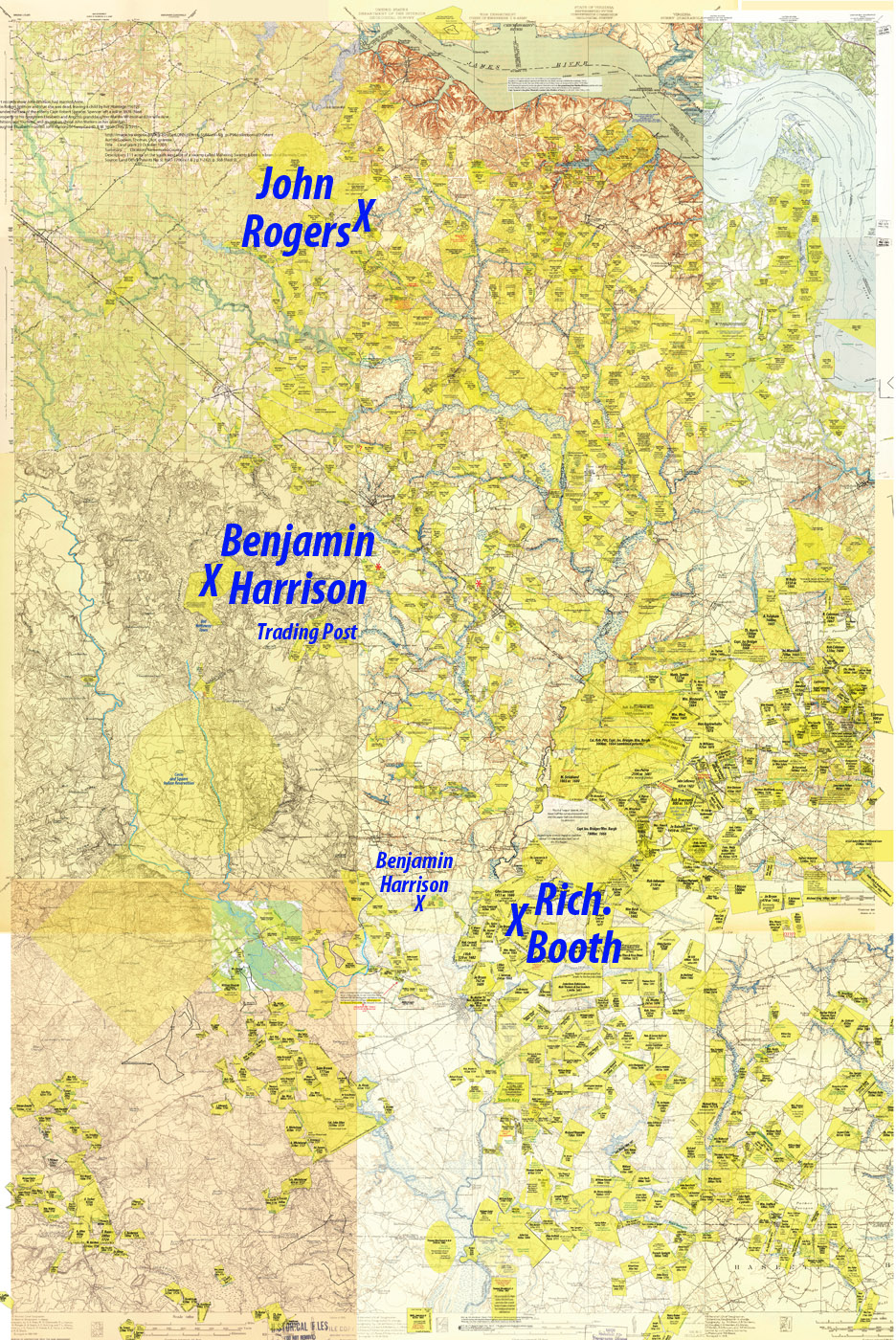
Here is a reference map… Benjamin Harrison had numerous patents in different places (most of which I have not researched)… the one near the “Circle and Square” Indian reservations is interesting because of the depositions referencing the various Indian tribes. I see no reason to doubt Mr. Harrison’s testimony on the historical facts… but I think you have to read between the lines to sort out the truth from his lies… The basis of the boundary dispute was that Virginia insisted the line should be drawn from Wiccacon Creek in NC and not the Nottoway River. They persisted in claiming the Weyanoake Indians lived on Wiccacon Creek. Harrison himself contradicts that assumption…consider the actual testimony of Harrison: [in 1663] “they found the rest of the Waynoak Indians by the side of a great Swamp to the Westward of Nottoway River sheltered with a peace of a puncheon fort; about five or six miles from their Town; which was then called Wariecoke, standing near the banke along the South side of Nottoway River…”. Just look on my map to see where the moron was referring:
The detailed map is here:

memo to Holmes…
Sir:
Regarding the case of Daniel McDaniel… I have followed a few leads in Surry County and found a rather incriminating reference to our man in the will of one Lawrence Fleming in 1710. Apparently this McDaniel fellow was indebted to Mr. Fleming but found favor with the dying man since he forgave the debt if the son of McDaniel was “schooled” as it were. As you no doubt surmise, this puts our man McDaniel in the awkward position of being married before we picked up his trail in North Carolina. Since I find no property attributed to our man, I can only assume that he was of the “working” class… ahem. The sordid notes are in my Page for McDaniel which I have diligently updated. How and when he arrived in Virginia is still a mystery.
As to his criminal involvement in the death of the good Reverend Ebernezer Taylor, Clerk, “dec̄ed”, I am still at an embarassing loss to find any hard proof that it was “our” man and not another fellow with the same name as Daniel McDaniel. It seems that another McDaniel had taken up residence in Carteret Precinct in 1723 and left a record in a list of Jurymen. The notorious Rob’t Atkins also left his footprints in said County. I find it suspicious that our man was furiously wheeling and dealing property between 1717 and about 1722… I cannot ascertain where he was living and find it rather frustrating as he seems to have several involvements with different properties. However it opens the possibility still that he is our culprit and may simply have spent a short time in Carteret County. A sly move on his part as it establishes an alibi if such be the case.
Again, as you no doubt surmise, since he had a wife (possibly) and a known son in 1710, his age may have been perhaps 25 (a guess, forgive me)… Alas the poor woman MUST have met her demise before 1715 as the cad remarried a mere child of 15 or 16 years! Scandalous! Proof of this nefarious marriage is found in a deed in my notes.
The poor child, not knowing any better obviously, stayed with McDaniel until his death in 1733. Which begins another mystery of one John Anderson who seems to marry the befuddled widow sometime after her widowhood and obviously partaking of his rather sizeable estate, I might add. The ONLY clue and lead I have at this point is a rather unremarkable reference to a man of his name as a “headright” in 1683. Forsooth Holmes! I need more evidence!
as always, your faithful servant, etc, etc…
Postscript
A CLUE Holmes!
I just uncovered evidence of the suspect, dare I say rogue Robert Atkins! (I leave it to you to ascertain whether he was indeed a mutherer, of course). The noted detective, Bob Baird, detailed some interesting court documents in his own investigations. Vis…
0 Feb 1711/2 Special Bail: In the suit of Richard Rogers vs. Daniel MackDaniel, the plaintiff demanded special bail whereupon Richard Blow became the defendant’s bail, and judgment granted plaintiff for 50 shillings. [Surry County Orders 1691-1713, p389]
”Special bail” was a relatively uncommon occurrence. It meant that, if the defendant failed to pay, the special bail would pay on his behalf – or, in the extreme case, would serve his time in debtor’s prison. Richard Blow’s relationship with Daniel McDaniel must have been a reasonably close one to undertake this action.
Note, Holmes, that we are not the only ones who are suspicious of this McDaniel fellow… Mr Baird evidently also has his eye on him. And with good reason I might add. One Robert Atkins was also lurking in the shadows at about this time and place…
18 Jul 1718 Robt. Atkins appointed overseer of the highways from Richard Blow’s through the main Blackwater Swamp by Joseph Wall’s. [Surry County Orders 1713-1718, p148]
Is this proof Holmes? Is this sufficient evidence for an indictment? I leave it for you to decide.
… again, your humble servant, etc, etc….
Holmes (in reply):
Nice try Dear fellow… but no cigar. The Robert Atkins you mention stayed in Virginia while our suspect was simultaneously dealing his dirty deeds in North Carolina. Unless he had a son by the same name then your efforts were for naught. Have a Scotch… Rethink… and perhaps move your investigation to North Carolina.
Holmes
My notes as usual can be found in my Pages… Daniel McDaniel, Sarah McDaniel and John Anderson….
George Anderson of Granville, d.1757
I’ve updated his Page with a few factoids… estate papers and such. I also bring in the Sims brothers who had property in Occoneechi Neck in the 1720s. I suppose it is possible that this George Anderson could be a son of the “mystery man” James Anderson who first shows up in 1716 but I can’t find a spec of proof to make a connection. There is also an Alexander Anderson “of Granville” which I can’t even find enough info to speculate about?
George and his brother William Anderson just “show up” in Granville in 1755… they had to have come from “somewhere”??? Clues people… I need clues.
Just to stoke the fire a bit concerning the Sims…
THE NORTH CAROLINA GENEALOGICAL SOCIETY JOURNAL, Volume XX, No.2, May 1994
…while going through South Carolina’s DOCUMENTS RELATING to INDIAN AFFAIRS, several lists of Indian traders appeared. These lists were generated by laws created by the colonies of Georgia and South Carolina to control Indian trade within their own borders. The first laws monitoring Indian traders in South Carolina were inacted in 1702. They were specifically directed against Virginia Indian traders. One of the first Virginia Indian traders whose property was “confiscated” becasue of this act was Robert HICKS[Sr.]of Virginia in 1707.(18)
Similar acts were also made in Georgia. On 9 January 1735, “An Act for the Maintaining Peace with the Indians in the Province of Georgia” was passed by the Common Council of Trustees at Governor OGLETHORPE’s insistence. It was sent to the Privy Council for review and a favorable report was rendered on 3 April 1735. It said:
..”that all such Persons that shall trade, traffik or Barter with any Indian (except the Chickasaw traders)shall come to the Town of Savannah at least once every Year; in order to take out a new License, in his own proper Person, that is to say, in the Month of March, April, May or June in which Months all Licenses shall expire [except] the Chickasaw traders shall take out their Licenses once in eighteen months…”(19)
Using the names of “Licensed Indian traders”, a list of Virginai, North and South Carolina traders was created. A partial list includes Robert LONG, Charles HICKS, John BROWN, William GILCHRIST, Abraham COLSON, James ANDERSON, William KEMP, James MOORE, Richard HYDE, John SIMS, William WILLIAMS, and John PETTYGREW.
December 31-January 7, 1736
Williamsburg Gazette
By a Letter from Col. James Millikin, in North-Carolina, dated at Roanoak, December the 10th, we have the following Account, That he received a Letter from Mr. Thomas Brown, of the Cutaboes, the chief Trader there, informing him. That on the 9th of October last, Three Indians came to the House of one William Syms, on Pine tree Creek, and (in his Absence) killed his Wife, another Woman, Three Children, and a Negro Man; and then set Fire to the House, Tis suppos’d they carried a White Girl away with them alive, who liv’d at the House, but can’t be found.
They were followed the next Morning by Five White Men, upon the Track, who found they had stopp’d in the Night, near a Place called Mars-Bluff, on Pedee River, where they had shared the Plunder, and left the bloody Cloaths of the murdered People. The Indians bent their Way Northward, which makes it believ’d they were Tuskaroroes. Mr. Brown wrote the above Account to Col. Millikin, at the Request of the Governor of South-Carolina, desiring him to use his Endeavours to apprehend these horrid Murderers
The story ends here… where did it start?
Copperhead
 I think I’ll take a few grandkids to see this tonite… 2 14 year olds and a 12 year old. Boys. The 2 granddaughters may not be interested… but I will invite them.
The 12 year old explained to me about 6 months ago that he did not care for Confederates. (He overheard a discussion between me and his father… I was reading Shelby Foote’s Trilogy of the Civil War). I asked him if he knew that he had 4 ancestors that were Confederate soldiers in the war… and two of them were killed in action. I asked why he thought the South was on his scorn list… he said his teacher said the South and Confederates were bad because they had slaves. (uh… its not that simple folks).
I’ve noticed a trend in Education the last couple decades… South… Bad.
The free book to read online is below…. written 1893.
http://archive.org/stream/copperhead00fred#page/n5/mode/2up
———–
update….. Its a history movie… and it is “objective”. Its “PG 13” OK for kids but the under 13 crowd may not understand (they don’t teach this stuff in school anymore).
This was a case of Northerners shunning Northerners (a kind of 1862 political correctness, if I may juxtapose 150 years).
Thumbs up.
http://www.americanthinker.com/2013/06/copperhead.html
When my grandson gets a bit older , I think I’ll have him read this:
James Anderson of Perquimans d.1742
Well I moaned and groaned a bit about buying another book in an earlier post but it turns out to be a good buy. I found a petition of the James Anderson of Perquimans that reveals a wealth of new information. Not so much as to glean any new info on his son James… who I “think” may be the progenitor of the Pitt County Andersons, but it does offer many other folks to research. Those other folks may lead to new clues. All of my research for that James Anderson is found on this Page…
Here is the petition from the NC Archives

Yeah, tough to read, I threw it in for fun… here is the transcript …
The Colonial Records of N.C. (2nd Series, Vol VII), Records of the Executive Council, 1664-1734, Edited by Robert J. Cain, p 637
Petition to President and Council
Date Undetermined (after 1707… per will of the widow of Thurston)
North: Carolina ss. To the Honorable President and Council
The Humble petition of James Anderson
Humbly Sheweth
That your petitioner haveing maryed Deborah the Daughter of John Thurston deceased who bequeathed by his last Will and Testament his Estate after the Death of his Wife to her Children and left his said Wife and his Son John Executors who are both Since Deceased and the said Mary Executrix of the said Will Surviving the said John the other Executor the said Mary by her last Will did leave Emund Maudlin Executor in trust for the Estate of the said Children Now Soe is it may it please your Honors that all the Children being of Full Age and capeable of Manageing their Legacyes themselves the Said Emund Maudlin doth utterly refuse to render an Account of the said Estate or Deliver the Same.
May it therefore please your Honors to take the premises into your Serious Consideration and Order that the said Emund Maudlin may be Compelled to Deliver and pay the said Estate according as it be queathed by the Will of the Said Thurston. And Shall pray etc.
——————————————–
Here are a few records from various sources…
The North Carolina Historical and Genealogical Register , Vol 1, Hathaway, p. 199
John Thurston & Mary Andrares was Married the ____ August 1669 by Mr. Jeremia Taylor Minister.
What in the world are we to make of the name “Andrares”….. Andrews?
John Thurston the son of John Thurston & Mary his wife was borne the 18th of October 1677. p. 206
James Sanderson married Deborah daughter of John Thurston, dec’d, her brother John Thurston, (1702).. p. 142
This is obviously “Anderson” and not Sanderson. (since this fooled Hathaway it might pay to double check any “Sanderson” records)
John Thurston, 10 Apr 1692, Son and Executor: John. Witnesses: Francis Tomes, Thomas Holmson (?), Samuel Nickellson. No probate.
————
Minutes of the Perquimans Precinct Court
North Carolina. Precinct Court (Perquimans Precinct)
July 08, 1701 – July 09, 1701
Volume 01, Pages 548-550
p. 549
Juliana Lakar and Ruth Laker Proved A Will of Beniamen Laker by ye Oathes of Richard ffrench And Elisabeth Steward Debro Thuston John More vars Daniel Snooks
Minutes of the Perquimans Precinct Court
North Carolina. Precinct Court (Perquimans Precinct)
February 09, 1703
Volume 01, Pages 575-577
p. 576
Upon a Petition of Mary Coffen Widd
The Sd Mary proves three rights being for the transportation of ffrancis and Mary Coffen and Jno Thursten and Assignes them to her Sonne in Law Richd Rose.
————————-
COFFINE, MARY
June 17, 1707. July 8, 1707. Deceased husband: JOHN THURSTON. Daughter: HANNAH THURSTON. Granddaughter: SARAH ROSE. Executor: EDMOND MODLIN. Witnesses: GILBERT SMITH, DERBY BRAYEN. Clerk of the Court: THOS. SNODEN.
(Source: Abstracts of North Carolina Wills, By: J. Bryan Grimes, Secretary of State, 1910, Page 75)
LAKARO (or LAKERS), BENJAMIN
April 7, 1701. July 8, 1701. Wife and Executrix: JULIANA (land on Parishes Creek). Daughter: SARAH HARVEY (book, “Grantham’s Church Principles”). Friend: GEORGE BLEIGHTON (“one book, being an Exposition upon the five books of Moses”). Witnesses: RICHARD FRENCH, ELIZABETH STEWARD, DEBORAH THURSTON. Clerk of the Court: JOHN STEPNEY.
(Source: Abstracts of North Carolina Wills, By: J. Bryan Grimes, Secretary of State, 1910, Page 206)
ANDERSON, JAMES
February 6, 1741-1742. December 14, 1742. Sons: JAMES and JOHN. Executor: RICHARD SKINNER. Witnesses: THOMAS JESSOP and THOMAS BATEMAN. Proven before W. SMITH.
(Source: Abstracts of North Carolina Wills, By: J. Bryan Grimes, Secretary of State, 1910, Page 7)
ANDERSON, JOHN
January 27, 1744-1745. March 5, 1745. Executors: CHRISTOPHER SUTTON and ABRAHAM MULLEN. Other legatee: JANE MULLEN. Witnesses: GEORGE WOOD, ELENDER MULLEN. Proven before GAB JOHNSTON.
(Source: Abstracts of North Carolina Wills, By: J. Bryan Grimes, Secretary of State, 1910, Page 8)
RECORDS OF DEEDS
ABSTRACTS COMPILED FROM BOOKS IN THE COUNTY REGISTER’S
OFFICE
DEED BOOK A
No. 13. John Lilly of Perq, in Co of Albemarle, Province of N. C. planter—for 1940 lbs of Pork pd by Wm. Foster of Afore’ Planter—“do sell my plan’ 150a on North-side of the mouth of Perq River.” Jan. 31, 1682. Test’ Samuel Woodrove, Alex Speed, John Thurstone.
No. 321. John Johnson of Perq Pre’ct, for a Con’ pd by James Anderson of same, 15a, being “part of a tract” belonging to John Thurston, (63a) at the mouth of Suttons Creek, adj Joseph Sutton Jun’r, & John Kinsey. Dec. 12, 1711. Test’ Edward Sweeney, Joseph Sutton.
Coffin, Francis, m Mary Thurston, July 21, 1692. (Berkeley Par Reg) d May 5, 1700.
You never know where a record may pop up…
I’ve yet to find the time to properly dig into the Colemans of Edgecombe County, NC… they were neighbors of my guys. I’ve tracked them a bit… enough to pique my interest that some started out near modern Petersburg, VA in the late 1600s. One of these “Prince George County” Andersons settled for a time near Ococneechee Neck in Bertie County (the early Bertie) ca. 1733. That John Anderson left no descendants that I can find. It is interesting though, that he was there… and why? My guess is that he was involved in the Indian Trade as were numerous other folks. But that is not my point of this post.
The information that we are able to access now, due to the internet, is truly amazing… this obscure book references an obscure law case of 1793. The case references one Francis Coleman who made his way to North Carolina in 1705. He brought back an Indian Woman as a slave.
Virginia reports: Jefferson–33 Grattan, 1730-1880, Volumes 1-2; Volume 21 By Thomas Johnson Michie, Thomas Jefferson, Peachy Ridgway Grattan (pg495) Coleman v. Dick & Pat. October Term, 1793
This was an action of assault and battery, and false imprisonment, brought by the appellees, in the District Court of Petersburg.
Plea, that the plaintiffs are slaves—Replication, that they are free and not slaves, and issue thereupon. The jury found a special verdict in the following words viz. “We find, that the plaintiffs are lineally descended by the maternal line from Judith; that Judith was an Indian, or the descendant of an Indian. That she was brought into this state by a certain Francis Coleman, sometimes after the year 1705, and was held as a slave, to the day of her death. If the law be for the plaintiffs, we find &c.”
(The descendants of the slave Judith (Dick & Pat and others) won their freedom about 1793 in VA)
Virginia Genealogical Society Quarterly, Volume XXIX, Number 1 (01-FEB-1991)
Prince George County, Virginia Wills and Deeds, 1710-1713
p. 13 Will of William Borne of Bristol Parish, Prince George Co, of “sane & perfect memory” Estate to be equally divided between Fra. Coleman’s two sons; and I make him my executor; but if he happens to die at Carolina, I make his wife my executrix. 14 April 1708
Signed: Wm (X) Bornes
Wit: Rich’d Smith, MATTHEW ANDERSON
9 Jan. 1710, proved by above witnesses & recorded
Matthew Anderson,Sr. to Daniel Nance
02/11/1716 100 acres Pr. G. Co.
Pr. G. Co. Book 1713-1728 Part I page 139
Bounded by Bayley’s run, David Crawley, Francis Coleman, and Maj. Robert Munford.
James Anderson
Matthew Anderson
Prince George County Wills and Deeds 1710-1713, page 14.
Dee, 7 Feb. 1710, William Coleman Jr. of Prince George County, to Robert Munford of same, for 5 shillings, 100 acres of land called “Haycocks”, bounded by land of John Coleman, land of JAMES ANDERSON, William Coleman, Matthew Anderson, George Downing, Robert Tucker & Samuel Vaughn. Said land was given to said William by will of his father, Robert Coleman, late of said county, dec’d, dated 17 Jan. 1675, to hold land one year.
Matthew Anderson,Jr. to Robert Munford
02/07/1714/5 100 acres Pr. G. Co.
Lands next to Math. Mayse, John Mayse, formerly property of Henry Newcomb, “Haycocks”, Robert Tucker, John Coleman, formerly belonging to William Byrd.
———
In the period of 1705-1708 (in my opinion) the only people settled around Occoneechee Neck, NC and the Tarboro area were Tuscarora Indians. Francis Coleman may have been trading with them. Or he may have made his way to South Carolina to trade with the Catawba, Cherokee or Chickasaws. All of which is a guess of course… but then… what else would he be doing?
——–
Oh… and Dr Cary… this is one of the reasons I think Peter Anderson may have come from Prince George County… the ancestor of the Bigins Sturdivant came from the same area of Virginia.
Why I dislike William Byrd II…
This guy’s father was the stuff of what America was made of… the son… not so much…
Firstly, the guy was a bit uppity. He had a tendancy to feel up slave girls. Then he bragged about it in his diary. That is a pervert. Secondly, he thought, incorrectly, that if a man pronounced his name as it was given to him at birth in the Latin terminology that he was evidently stupid that he did not use the Anglicised version.( That is what pissed me off personally… my ancestor, if that be the case, was not privy to the insult so I am acting in his stead.)

William Byrd wrote two versions of “The Dividing Line Twixt Virginian and North Carolina” or however he styled the books… in 1728 he started on the coast of NC and then proceeded to the mountains of western NC… along the way he passed a guy who “may” be one of my ancestors, Carolus Anderson..
One book was meant for regular folks who were unable to understand how smart he was….
“4th. The river was here hardly fordable, though the season had been very dry. The banks too were so steep that our horses were forced to climb like mules to get up them. Nevertheless we had the luck to recover the opposite shore without damage.
We halted for half an hour at Charles Anderson’s, who lives on the western bank of the river, in order to christen one of his children. In the mean time, the surveyors extended the line two miles and thirty-nine chains, in which small distance Meherrin river was so serpentine, that they crossed it three times. Then we went on to Mr. Kinchin’s, a man of figure and authority in North Carolina, who lives about a mile to the southward of the place where the surveyors left off. By the benefit of a little pains, and good management, this worthy magistrate lives in much affluence. Amongst other instances of his industry, he had planted a good orchard, which is not common in that indolent climate; nor is it at all strange, that such improvident people, who take no thought for the morrow, should save themselves the trouble to make improvements that will not pay them for several years to come. Though, if they could trust futurity for any thing, they certainly would for cider, which they are so fond of, that they generally drink it before it has done working, lest the fermentation might unluckily turn it sour.
It is an observation, which rarely fails of being true, both in Virginia and Carolina, that those who take care to plant good orchards are, in their general characters, industrious people. This held good in our landlord, who had many houses built on his plantation, and every one kept in decent repair. His wife, too, was tidy, his furniture clean, his pewter bright, and nothing seemed to be wanting to make his home comfortable.”
My apologies… I have the book with both versions… I’m lazy today and did not correct the quote below…you will get the drift..
Ahh… Mr Byrd… what did you really think of Mr. Kinchin’s wife?`
April The Secret History
thank God we got all well on the other Side without any Damage. We went to a House just by the River-Side, belonging to a Man, who learnedly call’d himself Carolus Anderson, where we chris- ten’d his child. Then ^e proceeded to M”” Kinchin’s a Man of Figure in these parts, & his Wife a much better Figure than he.^* They both did their utmost to entertain us & our People in the best Manner. We pitch’t our Tent in the Orchard, where the Blos- soms of the Apple Trees mended the Air very much. There Mean- well & I lay; but Firebrand & his Flatterers stuck close to the House. The Surveyors crost this River 3 times with the Line in the Distance of 2V-z Miles, & left off about half a Mile to the Northward of this Place.
Aside from the “gentleman’s” observations on people beneath him… he did a pretty good job on the boundary line.
“learnedly” call’d himself Carolus”… come now, Mr . Byrd even 300 years later we know an insult when we hear it… Laugh out Loud! RIP, sir.
Sweet fellow… not exactly what I consider a Gentleman, but I am grateful that he left a historic record of an obscure Anderson in 1728… I would have preferred that the reference not come from a pervert however. And I do hope I don’t sound “learned”… if so, it may be because my dear mother spelled my name Marc with a “C”… she just didn’t know any better.
2 Andersons in a petition 1732 (Edgecombe)
Well I just got soaked for another $30 in genealogy bucks. I visited an obscure site looking for an obscure person and up pops this petition of “maybe” 1732 showing 2 Andersons for that obscure time (1730s). I’ve yet to find another hard reference for a “Henry” Anderson in Edgecombe Precinct in the 1730s (the “County” came a decade later) .
My point is that in order for these two “petitioners” to be “of age” (21), then they would be born at least 1712… this makes them very early “Edgecombe” Andersons.
Note: The following petition is undated, but appears in the volume containing records from 1664 to 1734; and follows an entry dated November 11, 1732. A similar petition was filed by the citizens of Bertie Precinct.
Read the Petition of the Inhabitants of Edgecombe precinct which is in these words Videlicet
Petition of the Gentlemen of Edgecombe Precinct to alter the Seat of Government
To George Burrington Esqr. His Majestys Capt. General Governour and Commander in chief of the Province of North Carolina
We the Gentlemen and Freeholders of Edgecombe precinct think ourselves Extremely happy under your wise and prudent Administration the good order and peace we see now Established throughout this Province is a most convincing proof of your Excellencys Care and wisdom and deserves the thanks and gratefull Acknowledgment of all men in North Carolina
We are sencible Edenton is for many Reasons a very Inconvenient place for the Seat of Government and almost as much may be said against the settling it on Cape Fear River
Therefore we humbly desire and hope your Excellency will take proper measures for fixing the Seat of Government near the Center of the Province which we suppose is between Tar and Neuse River which will give a general Satisfaction to almost all the whole Province and greatly promote the speedy peopling the unsettled part of this Country increase the King’s Quitt Rents and Encourage Trade and Industry and be an Everlasting Demonstration of Goverour Burringtons Kindness to the Inhabitants of North Carolina
That you Sir may in health and happiness long Govern this Province are the Prayers of
Your Excellency most humble and most Obliged Servants
Tranker, James Simons, Will Williams, Pines Welding, Laurence Simcock, Edwd Robinson, Thos. Hodges, John Tapley, John Cotton, Willm. First, John Carpenter, Thos. Tapley, Willm. Reeves, John Robinson, Wm. Hamilton, Alexr. Beane, John Cor, Morris Orane, John Glover, Wm. Cullender, Joseph Richardson, Lewis Elliot, Silvester Estridge, John Gill, Jno. Doron, William Rusil, Chas. Merrit, Samll Murry, John Lew, Henry Anderson, Christ. Beane, James Moor, Benja. Joyner, Geo. Woodliff, Ricd Washington, John Mulkey, Philip Mulkey, Geo. Pace, Rodk. Pearce, Abrah. Ante, Thos. Perry, Danl. Kindal, Henry Jenning, Phil. Murray, Will. Williams Junior, William Paule, Wm. Bauldwin, Jno. Bobbett, William Dennis, Watkin Davis, Robt. Surloe, John Taylor, Thos. Goodson, Henry Guston, James Millikin, Jams. Thomspson, Thos. Jones, John Pratt, Jas. Dyal, Mathew Ruphen, Phillip Jackson, Lewis Davit, Robt. Humphreys, Robt. Humphreys Jr., Wm. Anderson, Thoms. Arrento, Richd Hainsworth Jr., Seth Vatcher, Thomas Hart, Jas. Brogden, John Smith, Robt. Ellis, Thoms. Riggin, Richd. Hill, Rob. Long Junior, Robt Warring, Jonathn. Wright, Will. Norwood, Berry Melton, Chas. McCulloe, Thos. Hicks, John Green, William Fish, Wm. Sturbidge, John Turner Senior, John Tayler, Edward Simons, Small Swaringham, Geo. Bollingson, Wm. Rushen, John Brooke, Wm. Hodges, Robt. Hodges, Danl Crawley,James Smith, John Rogers, Roger Case, Bat. Cheavers, John Branch, Thos. Bradford, W. Bulliloes, Thomas Blackman, Jno. Baldwin, Richd Merrick, Joseph Mechamp, Jas. Moore Junior, Alexr. Wright, William Moore, Walter Turburwell, Isheim Randolph, Nathan Joyner, Joseph Joyner, Gilbert Murray, Peter Ivey, Edward George, James Murray.
(A footnote states that another copy of the petition includes the names of William Whitehead, George Norris and Taphel Dyal.)
Source: Records of the Executive Council, 1664-1734, Vol. 7, (1984) pp. 298 – 299.
—————
So here went my $20 +plus shipping… to verify the above and perhaps find more clues…
http://nc-historical-publications.stores.yahoo.net/colonial-records-of-nc–2nd-series-.html
————–
There are actually 2 petitions in the records… one for Edgecombe “Precinct” shown above and the second from Bertie Precinct. The Edgecombe lists Henry Anderson and William Anderson. The Bertie list contains another William Anderson. So there are 2 Williams at this time of 1732(?).
I suspect the William Anderson of Bertie may be a son of Robert Anderson who lived around Cashy River. But that is a guess.
Two William Andersons that I can identify are the William who dies by 1762 (from Halifax) and my ancestor William who dies in 1789 (Edgecombe). So I have an obvious interest in the two men of that 1732? Edgecombe petition.
My “gut” is telling me the above William Anderson of the petition”may” be the guy who died in 1762. I have another theory for my guy of 1789. But I am open to any comments..
The “obscure” guys I was searching for were Henry Guston and James Millikin… who also show up in that petition. Millikin and perhaps Guston each become Justices of the Peace in that odd period of time when Chowan, Bertie and Edgecombe Counties were evolving and being chopped up into separate counties proper. Millikin is mentioned in other historical documents and very involved with the actual implementation of the future Edgecombe County.
Milliken and Guston were both Indian Traders and as I will show were not averse to travel to South Carolina and beyond to trade with the Cherokees. The unfortunate lack of info concerning James Millikin may be due to the fact that both he and his son of the same name both died before 1754… it may be that the line ended there? Any descendants may only be from the daughter Millikin.
Researcher Tommy Colbert transcribed this very telling deed…
Edge. Co. (Halifax) Db 6, page 140, deed date 29 Dec 1756, recorded
Feb Ct 1757, William Richmond, Esq, Edge. Co and Ann, his wife, to Jos.
Montfort, Gentleman, for 200 pds, a tract on the south side of
Conocanary Swamp containing 250 acres, being one half the land commonly
called the “old courthouse land” beginning at the mouth of Barneys
Branch then up the meanders of the said branch along the line of the
land which said Joseph Montford purchased of Simon Wade to three red
oaks then south 60 west along the head line of said line across the
said Barneys Branch to the dividing line between the said Wm. Richmond
and Paul Patrick then along the dividing line to Conocanary Swamp then
down the various courses of the said swamp to the beginning, which said
land was formerly sold by Dr. James Thompson and Mary, his wife, to
(Colo James Millikne), late of Edge. Co, deceased who died intestate
and thereby said land amongst other lands descended to the said (James
Killikne) the younger and after his decease to Paul Patrick and Agness
his wife and Ann Milliken sister and coheirs unto the said James
Millikin the younger and was by deed date 19 Nov 1754 among other lands
to Paul Patrick and Agness his wife and Wm. Richmond who intermarried
with the said Ann Millikin and Ann his wife copartners in the lands
aforesaid James unto (Wm K??) Jr of Edge. Co, Esq and afterwards by
deed bearing date 9 Dec 1754 was conveyed by the said Wm. Kinchell to
the said Wm Richmond, signed Wm. Richmond, Ann Richmond (mark), wit
George Gibson, John Cotton (mark). Abstracted 4-30-06, NCA film
C.047.40002, CTC.
Millikin died about 1737 … I found his estate records at NC Archives online http://mars.archives.ncdcr.gov/BasicSearch.aspx
Nathan Joyner was listed as one of his administrators. He married a Joyner.
He had to have came directly from Scotland as he is shown sending money back to his mother in Scotland. See about halfway below:

But back to the early James Millikin and Henry Guston…
COLONEL CHICKEN’S JOURNAL TO THE CHEROKEES, 1725
Thursday the 15 day of July 1725.
Arrived here from Tuccaseegee Samuel Brown and John Hewet who I sent for by an Order of the 8th Instant. And having Examined the said Hewet in relation to his being among the Indians without my leave, I found that he was Employed by Mr. Marr and that after he had left the said Marrs Employ that James Millikin Indian Trader Employed him and gave him Orders to Trade by two Letters from the said Millikin which the said Hewet produced to me and having Considered the aforesd Information, I gave Orders to the said Hewet to Stay at Keewohee til the said Milikin Arrived here from the Catawbaws at which time I informed him I should give him further Orders.
…
Wednesday the 3d day of August 1725.
This Morning appeared before me Ja: Millikin and Henry Guston to Answer a Complt agt them pursuant to my Orders of the 18th of July last in Relation to their Employing one John Hewet for one whole Year in the Indian Trade without my leave or Lycence which I proved before them by Two Letters from them to the said Hewet, wherein they Charge him not to Trade in the presence of any White Man for fear of his being discovered.
And the said Gustin and Millikin pleading that they Employed the said Hewet out of Charity and without any design of defrauding the Country or in Contempt of the Governnfent and hoping that I would take their Case under Consideration and to Shew them as much favour as the Circumstance of the Case would Admitt of, and as would seem mett with me, Promiseing for the future to take care of any further Complt against them, And on Considering the above Complt I Ordered them to give me a Note for the Sum of Thirty pounds payable to the Country it being there due from the said Hewet who Traded for them a whole Year without any Lycence and they having given me their Note accordingly on Mr. Saml. Eveleigh Mercht I then dismist them of the Complt agt them giving them in Charge to take care for the future how they behaved themselv’s, which they Promised to do.
…
Munday the 6th day of September 1725. This Morning came to me King Crow and some of his head men to Enquire w[ha]t was done with the boy they promised to redeem last Year. I told them that he was among the English learning to make Shoes and that according to their desire he would not be sent over the Great Water and that as soon as they had made a gathering among themselv’s of Skines to pay for him that they might then have him again as soon as they pleased, at which they went away well Satisfyed, the King and head men having heard that I designed to goe to Togelo parts informed me that he with some of his head Men would Accompany me there. Memorand : That John Facey and Wm. Collins are Allowed as Pack- horse Men to James Millikin Indian Trader, he having given an Order on Samuel Eveleigh Mercht in Charles Town payable to the Publick for the Sum of £20, it being required by Law for the Endorsement of the said Pack horse men. Given under my hand and Seal the date above written.
…Tuesday the 12 day of October 1725.
… Came in here from Great Terriquo Ja: Millikin Indian Trader who Informed me that the person (who lately brougt into the saidTown two Womens Scalps) with Eight more were gone out to Warr agt the Upper Creeks and that they had been out Six dales and that they were to return in Twenty dales from their sitting out. He likewise gave us an Accot that their Conjurer had given them Assurance of Success. I must remark that this is the Town that the Cowsaw fellow was reed in by the head Warriour there and by no other of the Town and I am very well Satisfyed that, that Town would never come into a peace (Assurance of wch) We have had since we have been here by their going out to Warr daily against the Creeks.
There are also instances back in North Carolina to undoubtedly link the association to the two Traders…
undated…
NC STATE WIDE – COURT – Colonial Court Papers, Group 2:
Freedom of slaves, Commissions for Edenton, Other papers related to slaves
Bond by James MILLLIKEN with Henry GUSTON, bondsman for a caveat
against anyone obtaining a writ to dispossess him a slave Jack, purchased from
Thomas CLEMENS and now in dispute with Robert WILLSFORD and Thomas BRYANT.
Witnesses: James CRAVEN, David ONEAL. n.d.
unsourced… I’m lazy today…
In 1727 James Castellaw went into business with Henry Guston and James Milikin at the confluence of the Cashie and Roanoke Rivers.
and my personal favorite…
December 31-January 7, 1736
Williamsburg Gazette
By a Letter from Col. James Millikin, in North-Carolina, dated at Roanoak, December the 10th, we have the following Account, That he received a Letter from Mr. Thomas Brown, of the Cutaboes, the chief Trader there, informing him. That on the 9th of October last, Three Indians came to the House of one William Syms, on Pine tree Creek, and (in his Absence) killed his Wife, another Woman, Three Children, and a Negro Man; and then set Fire to the House, Tis suppos’d they carried a White Girl away with them alive, who liv’d at the House, but can’t be found.
They were followed the next Morning by Five White Men, upon the Track, who found they had stopp’d in the Night, near a Place called Mars-Bluff, on Pedee River, where they had shared the Plunder, and left the bloody Cloaths of the murdered People. The Indians bent their Way Northward, which makes it believ’d they were Tuskaroroes. Mr. Brown wrote the above Account to Col. Millikin, at the Request of the Governor of South-Carolina, desiring him to use his Endeavours to apprehend these horrid Murderers
15 October 1732 Edgecombe County, North Carolina deed of William Sims to James Millikin for land on the south side of Quankey Creek [DB 1:20]
On motion of Mr James Millikin in behalf of the Inhabitants of that part of Bertie Precinct that lyes on the South Side of Roanoke River that a bill for an Act to be preferred to this house for Establishing that part into a precinct by the name of Edgcombe also on the Motion of Mr Maurice Moore in behalf of the Inhabitants of Onslow and Bladen that a bill be preferred to confirm them into seperate precincts which Motions are granted. http://docsouth.unc.edu/csr/index.html/document/csr04-0052 1735
??? William Syms Edgecombe County 24 Oct 1755
Will
Daughter: Sarah Whooper (plantation lying on Kehukey). Son: William.
Executor: John Whitaker. Witnesses: Thos. Taylor, Mary Tree, Xtr. Haynes.
No probate
——————————-
So… since we have a couple of die hard Indian Traders from North Carolina leaving their footprints all over South Carolina I figure I may not be totally off base by thinking that a James Anderson from NC may have been doing the same…
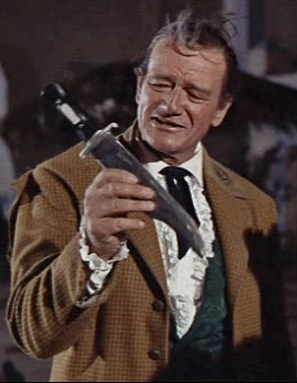
its a Booee knife..
…course I was born n’ raised in west Texas… as a kid we learned about Jim Bowie and the Alamo… I went to Travis Jr High in Snyder, Texas (which I think has been torn down).
Learning about the Alamo was a big deal to Texans when I was a kid. I still have a sense of pride about it… always will.
http://www.breitbart.com/Big-Government/2013/06/06/Fascinating-Maps-Of-Americans-Dialects
