Rachael Anderson of Edgecombe
This isn’t a breakthrough post… just a few more interesting clues into:
Rachel Anderson (assumed to be the daughter of William Anderson d.1789 and Mourning Price m. 1763)
1800 census
1m to 16
1f to 10
1f to 45
1810
2m to 26
1f to 26
1f over 45
1 S
Not on 1820 census…
—————————-
Holmes found this abstract recently from Watson’s “Kinfolks”…
Deed Book 17, page 246
May 1, 1820
Rachel Anderson makes a deed of gift to her daughter Elizabeth Anderson and to her grandsons Bennett Anderson, George Anderson, and Gralndes Anderson. (sic)
“That’s all – it’s just an abstract. Note the horrible spelling of the grandsons’ names. Could the last one be Geraldus???”
—————————–
My buddy Floyd, conspiring with Holmes, found this deed in the Tarboro records revealing Rachal Anderson selling a parcel of land to her daughter Elizabeth in April, 1821. The land is described as “the north side folkes branch” which is ground zero of the Anderson clan of William Anderson d.1789.

So, needless to say, all of us researching these folks are in a snit fit to obtain the deed above which mentions the grandsons of Rachael Anderson!
————————-
Which brings us to this… remember Rachel is over 45 in the 1810 census…
Griffin, James – Rachael Anderson, 29 Aug. 1825, Burrell Hill, (w) N. Mathewson
(Marriages of Early Edgecombe County, 1733-1868, Williams & Griffin, 1958)
Note the witness above (Burrell Hill d.1846)… who lived at the time, you guessed it, within a stone’s throw of the Anderson clan…
Edge. Co. Db 18, page 490, deed date 31 Aug 1826, recorded Aug Ct
1826, David Barnes, Edge. Co to Zachariah Griffin, county aforesaid for
$200, a tract of land with all improvements containing 100 acres which
said land was sold by Spencer L. Hart, sheriff as the property of
Josiah Worrell as will more fully appear by reference to his deed to
Henry Austin and Thomas Hadley dated 8 Jan 1820, and by said Austin and
Hadley sold to the said Barnes 17 Aug 1826, the date of this indenture,
adjoining the lands of George Anderson, James S. Battle, Rachel
Anderson, Henry Austin and Burrell Hill, and it is understood that all
part of the aforesaid premises which the said David Barnes has devisedd
from said Austin and Hadly is hereby conveyed, signed David Barnes, wit
H. Austin. Abstracted 12-20-06, NCA film C.037.400015, CTC.
Well, an observation from “Joani” brings a little clarity to this James Griffin question… she cites a reference to the will of Zachariah Griffin which seems to identify James as his son:
Griffin, Zachariah will Apr. 26, 1837, no probate date, wife & extx.
Margaret, lend tract whereon I now on lines of John Anderson, now Lot
Stallings line on east side of Grassy Branch, one negro, pot and books, Dutch
oven, pr. flat irons, griddle, skillet, mare, side saddle, bridle, china
press and contents, riding chair and harness, stone jar, 4 good sitting
chairs, trunk, chest, table, sow and 14 pigs, shoats, cow and calf or
yearling, loom and gear, 6 geese, pork, corn, wheat, 20 lbs sugar, 10 lbs
coffee, 3 bu. salt, 5 gal. molasses; dau. Maria Ruffin, wife of John
Ruffin, land whereon they live; Martha Hawkins, wife of Fredrick Hawkins,
land whereon they live; the two tracts being lands bought of David Barnes and
James Griffin; residue to be divided between dau. Elizabeth Spicer, heirs of
James Griffin, heirs of Oney Hill, Rebecca Moore, Winifred Sawyer, Mariah
Ruffin, Martha Hawkins, exr. Jesse C. Knight, wit. William Hinton, David
Matthews. Abstracts of Wills, Edgecombe Co., NC, 1733-1856, Williams &
Griffin
Since this is a bequest of property in his will it makes sense this is his son… Joani further states the wife of James Griffin was Rachel “Jones”… she calculates his birth to be between 1790 and 1800. This clue was also noted by David Gammon:
Gammon III pg 42 #176 4/26/1827 May Ct 1839 F-233
Daughter Mariah md. one of the John Ruffin, Dau Martha MD Fredrick Hawkins, dau Elizabeth md. Spicer, His will also names James Griffin’s heirs, Oney Hill’s heirs, Rebecca Moore and Winnyfred (sic) Sawyer with no relationship identified. (Winnifred Griffin md. Issac Swyer 5/12/1830, Martha Griffin md. Fredrick Hawkins 5/27/1834, Rebecca Griffin md Moses Moore 1/16/1830)
This leaves the 1825 marriage of Rachel Anderson/James Griffin another mystery. Who are they?
—————-
Here we have Rachel and (her daughter?) Elizabeth…
Edge. Co Db 19, page 415, date of deed25 Jan 1827, date recorded Aug Ct. 1829, Zachariah Griffin to Allen Jones, for$120 a tract of land beginning at a white oak Rachel Griffin’s corner then down the branch to George Anderson Sr’s corner gum then up the branch to James S. Battle’s corner then along said Battle’s line to a litewood stump then down the line of said Griffin and Battle to beginning white oak, signed Zachariah Griffin, wit. B. Wilkinson, Josiah (Spier or Spicer). Abstracted 10-10-00, FHC film 0018895, CTC.
Edge. Co. Db 19, page 368, date of deed 20 July 1828, date recorded
May Ct. 1829, Allen Jones, (residence not given) to Elizabeth Anderson
(residence not given) for $40, a tract of land beginning at a stake
Rachel Griffin’s line then a north course agreed line to a stake then
along a new line of marked trees to a ( ) gum in the Branch then
down the various courses of said branch to a black gum and pine in said
Griffin’s line then along said Griffin’s line to beginning, signed
Allen Jones, wit. B. Wilkinson, (Julian) Ezell. Abstracted 10-10-00,
FHC film 0018895, CTC.
This will has James Griffin dead by 1837 (assuming it is the right James). This suggests that he was not a spring chicken himself when he married the 55ish year old Rachael… He is likely in his 40s… per Joani’s notes.
Griffin, Zachariah will Apr. 26, 1837, no probate date, wife & extx.
Margaret, lend tract whereon I now on lines of John Anderson, now Lot
Stallings line on east side of Grassy Branch, one negro, pot and books, Dutch
oven, pr. flat irons, griddle, skillet, mare, side saddle, bridle, china
press and contents, riding chair and harness, stone jar, 4 good sitting
chairs, trunk, chest, table, sow and 14 pigs, shoats, cow and calf or
yearling, loom and gear, 6 geese, pork, corn, wheat, 20 lbs sugar, 10 lbs
coffee, 3 bu. salt, 5 gal. molasses; dau. Maria Ruffin, wife of John
Ruffin, land whereon they live; Martha Hawkins, wife of Fredrick Hawkins,
land whereon they live; the two tracts being lands bought of David Barnes and
James Griffin; residue to be divided between dau. Elizabeth Spicer, heirs of
James Griffin, heirs of Oney Hill, Rebecca Moore, Winifred Sawyer, Mariah
Ruffin, Martha Hawkins, exr. Jesse C. Knight, wit. William Hinton, David
Matthews. Abstracts of Wills, Edgecombe Co., NC, 1733-1856, Williams &
Griffin.
(The references above place this land very close to this discussion of Rachael Anderson- unfortunately, I can’t find any estate records or will for James Griffin as yet. So the easy assumption is that Rachael and James died prior to 1837… but it is unproven.)
But to further press the likely marriage of Rachel Anderson and James Griffin note this deed reference of 1832…
Edge. Co. Db 20, page 288, deed date 25 Aug 1832, recorded Aug Ct
1832, division of the land of Allen Jones, dec’d, lot 1 to Mary Worrel
beginning at a pine in James S. Battle’s line then south 70 poles to a
black gum on the south side of Folks Branch then south 50 east 20 poles
to a black gum on said branch then south 6 west 40 poles to a hickory
then east 52 poles to a pine then north 46 poles to a holly and ash on
said branch then north 20 west 122 poles to a sassafras then to first
station, containing 39 3/4 acres; lot 2 to Nancy Jones beginning at a
stake in the field and running south 88 east 150 poles to a pine in a
small branch then south 25 west to a small gum on said branch Rachel
Griffis corner then north 86 west 38 poles to a stake Rachel Griffis
other corner then south 5 east to a stake then south 87 east 16 poles
to a small hickory then south 5 west 16 poles to a ash in Folk’s Branch
then south 88 west 40 poles to a holly and ash on said branch then
north 20 west to first station containing 37 acres and pay #1 $2.75;
lot # 3 to James Griffin in right of his wife Rachel beginning at a
stake field corner of lot #2 then south 88 east 150 poles to a pine in
a small branch then north 25 east to a gum and oak on said branch then
north 74 west 128 poles along a line of marked trees in Joab S.
Battle’s line then west 67 poles to a sassafras corner of lot #1 then
south 20 east 55 poles to first station, containing 37 acres and pay to
lot #1 $2.75, signed ?. Abstracted 12-12-00, FHC film 0018895, CTC.
Hmmm… It appears James Griffin may be the brother of the above Allen Jones or just Nancy Jones (I’m not sure how to interpret this?)… Rachel is his sister.
source: familyserach.org, NC Estate Files, 1663-1978, Edgecombe County, J, Jones, Allen (1831)


Floyd sent me this deed of 1834… James Griffin and wife Rachel along with Nancy Jones sell to Zachariah Griffin 187 acres… part of which “fell to them by the death of the late Allen Jones” … I still can’t figure out if it is James or Rachel that is related to Allen Jones? Obviously Nancy Jones was.

————————
Another perplexing question… is this the daughter of Rachael?

Ct. 1801, Richard Bell, Edge. Co. to James Griffin (alias) Williford
for $200, a tract of land on the north side of Hatcher’s Swamp
beginning at a red oak in James (Williford) own line then running south
80 poles to the center of a gum and sassafras then south 100 poles to a
gum on the run of the Raccoon Branch then along the various courses of
the said branch viz. north 15 east 43 poles then north 50 east 18 poles
north 16 poles north 27 east 10 poles then north 5 east 14 poles then
north 56 poles to the mouth of a small branch to a gum then along
(Dorman’s) line viz. north 80 west 65 poles to a black oak then south
20 west 73 poles to a pine James Williford’s corner then north 85 west
46 poles to the beginning, containing 84 acres, signed Richard Bell,
wit. G. Wimberly, (Ed) Hall. Abstracted 21 Mar. 01 FHC film 18887, CTC.
Henry Anderson d.1801
My buddy Holmes has contributed some fascinating insights to the Henry Anderson conundrum… fortunately my ego is not so fragile that I can’t fail to laugh my ass off when he takes his genealogy scalpel to my wild theorizing. The post below this one concerns the mystery Town William and may help to explain some of my errant writing…
He nonchalantly asks this question…
“Hmmmm….. based on that Lavina Anderson deed, her brothers William, Allen, and Frederick all died intestate by 1815 and without issue. So if the William left two daughters in Lenoir County, he cannot be brother of Lavina. Whatcha think?” … that’s when I knew I was in trouble…
————————————————————————-
Well, in cases like this we have to go back to an original will or something that directs us. And we go from there. Let’s look at 1802 Henry Anderson’s will.
The will of Henry Anderson who died 1802 leaves a life estate in half his personal property and a life estate in half his land to his wife Charity. Only cash is left to the daughters Polly (Mary) and Lavina. (He does not specifically state what happens to the other half of the land, but since the wife’s half is going to the sons, we presume they got the other half as well.)
All five sons were apparently living in 1802 at the time of Henry’s death, because several subsequent references state that they all inherited the land. Yet, in 1803, the cash from the estate was divided between Charity, Polly, Levina, John, Henry, and Frederick. This tells us William and Allen had died between the probate of the will (1802) and 1803. Yet, the land was not divided, most likely because some or all of those sons were still underage.
In 1807, the estate of 1802 Henry Anderson gets divided between Charity Gatling and the children of the deceased. I take this to mean she had married Benjamin Gatling about that time. Remember that the will of Henry Anderson left her half of everything for her lifetime or widowhood – so her widowhood was over when she married again. Or, it could be that the Gatling marriage had taken place much earlier, and maybe some of the children were now of age in 1807 and wanted their share. Widows with young children tended to get married fairly quickly – waiting five years would be a bit unusual. And if everybody was happy and underage, there was no need to go to court to have things divided.
So at the death of ANY of those sons without issue, their undivided share of the father’s land would go to ALL the surviving siblings or their heirs. This is when Lavina and Mary/Polly get in on the act, even though their father Henry did not leave them any land. And as it happened, THREE of the sons had died without issue by 1815 — William and Allen by 1803, and Frederick sometime between 1803 and 1815. And still the land was not divided, and I still believe this to be because there were minor heirs.
Let’s look at the acreage. It seems that the entire tract of land that Henry Anderson had owned contained 259 acres. If it went to five sons, each would have 1/5 or about 51 or 52 acres. This means that the total acreage of William, Allen, and Frederick would have been anywhere between 153 and 156 acres. (we multiply three times 51 or 52. Now at the death of Frederick you have four siblings remaining — John, Henry, Mary/Polly, and Levina. Let’s see what they owned:
John – his original 51 or 52 acres plus a fourth of 153 or 156, or 38/39 acres (total about 89 or so acres)
Henry – his original 51 or 52 acres plus a fourth of 153 or 156, or 38/39 acres (total about 89 or so acres)
Mary/Polly – her one-fourth of the 153 or 156, or 38/39 acres
Levina – her one-fourth of the 153 or 156, or 38/39 acres
Look at the deeds I abstracted below. There is Mary Anderson, now of Craven County, bold as brass, selling exactly 39 acres, God bless her. The 1815 deed from Levina does not state 38 or 39 acres, but it would have been the same.
So when we see that 1815 deed from Henry Anderson to Isaac Norfleet (below) we must presume it was for 89 acres or so.
…have the reference.
Note that everyone is selling to Isaac Norfleet . We can’t account for John, but I suspect he also sold to Norfleet, because all the shares were undivided, and it would have been very messy otherwise.
All this to say that William (son of 1802) Henry was dead by 1803, and without issue. And I suspect he was underage. We have several references to prove this William died without issue by 1803 – so the Town William is someone else.
DB 15/425 29 Dec 1815
Henry (X) Anderson to Isaac Norfleet
For $276, 259 acres, which was the bequest of Anderson’s late father Henry Anderson, deceased, at the death of his three brothers William, Allen, and Frederick Anderson. This was an undivided tract of land on the west side of the Tar River adj. James Garrett, said Norfleet, Henry Shirley, James Waller, Josiah Pender, Sterling Waller, and JosiahFreeman.
Wit. Rhetorick Lawrence, H. Austin
DB 16/64 3 Feb 1818
Mary (X) Anderson of Craven County to Henry Anderson of Edgecombe
For $100, 39 acres, being part of the lands of Henry Anderson, deceased,. Given by the said Henry to his then living sons, and this land fell to Mary by the death of three of his sons. Mary Anderson is sister of the grantee Henry Anderson.
Wit. Austin (X) Andleton
DB 16/90 24 Feb 1818
Henry Anderson to Isaac Norfleet
For $125, 39 acres , being the land that formerly belonged to Henry Anderson, deceased, which fell to Mary Anderson at the death of three of the sons of the said Henry Anderson.
Wit. Starling Waller
——————————————–
So all this throws some serious doubts on the speculation of the son of Henry Sr d.1801 (Henry Jr) moving to Georgia around 1804 (as I have in my “Page” on Henry).
I also speculate that son John may have served in the war of 1812….. all of which can now be re-examined… ya gotta love this hobby…
——————————————–
Inventory of Ann Gatling in 1814….Edgecombe
This is the mother of Benjamin Gatling who married Charity Anderson (relict of Henry Anderson d.1801)
Note the buyers… this places them in Edgecombe in 1814…
Mary Anderson
Lavina Anderson
John Anderson
Benjamin Gatling
(I don’t see a Henry Anderson)

1813, Benjamin Gatling and Ann Gatling, both of Edge. Co. to Isaac
Norfleet, county aforesaid for $267 a tract of land on both sides of
the road called the Georgia Road leading from Tarborough to Town Creek
Bridge beginning at a pine stump standing on the (Tea?) Road James
Garretts corner then running along said Garretts line, it being a line
of marked trees to pine standing in the line of the land of Henry
Anderson, dec’d then along his line to a red oak the corner of the land
of James Walton dec’d then along a line of marked trees north 50 west
to a stake standing on the aforesaid (Teak) Road then down the road to
the first station, containing 76 acres, signed Benjamin Gatling (X),
Ann Gatling (X), wit (Starling Waller), William A. ( ). Abstracted
4-22-04, NCA film C.037.40011, CTC.


————————–
Since all the sons are accounted for except John and Henry Jr, I have to speculate even with Holmes lurking about and sharpening his scalpel (its what I do)…
Noted in the Will of Henry Sr d.1801 are 2 “executors” …
Edgecombe County Will Abstracts 1793-1823 by David Gammon
(7) HENRY ANDERSON 24 Nov 1801 Feb Ct 1802 O D/137
“…being very sick…”
wife CHARITY ANDERSON – lend half of my land of my personal estate for her lifetime or widowhood. At her death or marriage her share shall be divided between my five sons WILLIAM ANDERSON, ALLEN ANDERSON, JOHN ANDERSON, HENRY ANDERSON and FREDERICK ANDERSON.
Sixty dollars of my estate shall be kept out, to be shared by my daughters VINEY ANDERSON and POLLY ANDERSON.
Ex. friends DRURY MAY, JOHN ANDERSON
Wit. JOHN LITTLE, P. SUGG
The term “friends” is used and it is “plural”…. does that mean that this John is not a son but a friend? The sale of the Estate is “executed” by Drury May(o) and John Anderson.
Another thought I have is that these two sons (John and Henry Jr) obviously appear to be of age (at least 21) and since the other sons who are demonstrably deceased seem to be underage perhaps the wife Charity was not the mother of these 2?
I have a blurb showing that a John Anderson of Edgecombe served in the War of 1812 (on my Henry 1801 Page)… other than that I have nothing else.
With the time spans involved it also seems unlikely that the Henry Anderson who wound up in Georgia (on my Page) is related.
EDGECOMBE COUNTY KINFOLKS by Joseph W. Watson
DB 8-686 SARAH ANDERSON, wife of HENRY ANDERSON was formerly SARAH COX, widow of ROBERT COX, dec’d., Aug. 6, 1796.
Edgecombe Co. N.C. Deeds Vol. 5: 1794-1798 by Stephen E. Bradley Jr
680-(686) Henry Anderson & his wife Sary (Sarah) of Edgecombe Co to Jesse Knight of same. 6 Aug 1796. £20. A tract which sd Sarah Cox now the wife of Henry Anderson has as right of dower at the death of her former husband Robert Cox dec’d. Wit: Allen Hardy, Frank Knight.
——————————
This deed seems to place Henry Anderson Jr still in Edgecombe in 1845…
Edge. Co Db 23, page 570, date of deed 17 Jan 1845, date recorded Feb
Ct. 1845, Isaac Norfleet estate to his wife, Christina Norfleet by
order of Nov. Ct. 1844, commissioners lay off to Christina Norfleet,
her legal dower in the land her late husband died seized and possessed
of, beginning at the fork of the road near the Garret House then south
59 east (305) poles to some small oaks in Josiah Pender’s line then
along said line north 71 poles to a pine Pender’s corner then north 80
east 120 poles to a pine Pender’s corner then north 41 poles to a black
oak then north 45 east 30 poles to a pine stump then north 12 ½ west 8
poles to Foxhall’s line then north 85 west 19 ½ poles to a stake then
north 13 west 78 poles to the creek then up the creek to the center of
two pines then north 22 west 37 poles to Eli Porter’s corner a white
oak and black oak then north 79 west 100 poles to a pine on the road
then along the road 56 poles to a branch then up the various courses of
said branch to the dam at some bay stumps Henry Austin’s corner then
along said Austin’s line north 117 ½ poles to a pine on the south side
of the pocoson then north 87 west 15 poles to a stake Austin’s other
corner then south 48 west 89 poles to two small pines Austin’s other
corner then north 132 poles to a pine L.C. Pender’s corner in Austin’s
line then along Pender’s line south 51 west 150 poles to a small
persimmon tree on the east side of Teat’s Road Pender’s other corner
standing in a small branch then along the various courses of said road
298 poles to the first station on the Raleigh Road, containing 661
acres, including dwelling houses, outhouses and where the said dec’d
most generally dwelt next before his death, signed Wm. S. Baker, L.C.
Pender, Robert Johnson, Amos Walston, David Hollon (D), Joseph Statting
(mark), Thomas Griffin (mark), Henry Anderson (mark), James Edge, R.B.
Sasnett, Henry Morgan, (L.W. Walker). Abstracted 4-10-02, Copy from
deed book, CTC.
And since Henry was associated with Isaac Norfleet I checked the Estate papers of Norfleet and Henry shows up once as a buyer…


I would shout from the rooftops at this point that lo and behold, the Henry Jr mystery is SOLVED!… except that there is another known Henry in Edgecombe at the same time (1845) so I can’t rule out that this is not him. Plus, Holmes has me gun-shy with my theories. He can be brutal.
——————————
a tidbit… I suspect this may be the possible Henry Jr… the other Henry at this time is Henry R. Anderson which may be my line. This deed prompted me to look at the Estate papers of David Holland mentioned in the deed. Henry served on the jury concerned with the disposition of some estate matters. This Henry has a signature mark “A” which I will show below.
Edge. Co. Db 24, page 542, date of deed 16 Nov. 1848, date recorded
Nov. Ct. 1848, David Holland estate to Patsy Holland, by commissioners,
her dower in the lands her husband died seized and possessed of,
beginning at a black gum in the long branch then north 35 east 98 poles
to a small pine Richd. Harrison’s corner then along Harrison’s line
south 81 ½ east 66 ½ poles to a small post oak in or near said
Harrison’s line then south 35 west 105 poles to a black gum in the long
branch then down the various courses of said branch to the first
station, containing 40 acres, William W. Armstrong, L.L. Dancy, Henry
Lloyd (MI either L or S), William Peel, Henry R. Johnson, William T.
Bryan, Thomas Norfleet, James Sherrod (X), Josiah Walston (X), William
Lodge (X), Henry Anderson (X), D.W. Bullock, wit. H. Hyman, Dpy
Sheriff. Abstracted 5-1-02, NC State Archives film C.037.40018, CTC.

source: familysearch.org Edgecombe Estates 1848
—————–
Bingo!… I found another signature to compare…
This is from the 1849 Estate papers of Reuben Johnston and his widow Elizabeth. This is Henry R. Anderson: (source: familysearch.org, Estate Papers, Reuben Johnston, 1849)

Below are other papers from the Reuben Johnston estate to add more info… Henry R. Anderson was an adjoining landholder…


So… my thoughts are these signatures match (the capital A in both) and Henry R. Anderson is the only guy left standing in regard to the 1845 Isaac Norfleet deed, the 1848 estate of David Holland, and the 1849 estate of Reuben Johnston.
Henry Anderson “Jr”, the son of Henry d.1801 has apparently disappeared after this 1818 reference:
DB 16/90 24 Feb 1818
Henry Anderson to Isaac Norfleet
For $125, 39 acres , being the land that formerly belonged to Henry Anderson, deceased, which fell to Mary Anderson at the death of three of the sons of the said Henry Anderson.
Wit. Starling Waller
——————
See my Page “George Anderson (b.1756) Edgecombe property” to get a map reference on the Henry R. Anderson and Reuben Johnston referenced above. This is why I think he was connected to the William Anderson d.1789 family. I cannot place him convincingly however. The son of 1789 William (the Henry who married Lovey Staton) seems to have died around 1830 but details are still sketchy and not worked out.
The “Town William” Anderson
Town William
Deed Book 9 Edgecombe Co
253-(199) William Anderson of the town of Tarborough to John Womble of same. 23 Oct 1798. £75. A fourth of lot 15 in the town of Tarborough, fronting St Georges Street.
Wit: John Turner, William Davidson. Proved May Ct 1799. Edward Hall CC
262-(205) Sally(x)Patterson & Sukey(x)Patterson, both of the town of Tarborough in Edgecome Co, to William Anderson of same. 23 Jan 1798. 35 silver dollars. Lot 15 in the town of Tarborough.
Wit: John Turner, Josiah Ives. Proved May Ct. 1799. Edward Hall CC
438-(365) John Womble of Edgecombe Co to William Anderson of same. 6 Apr 1799. 150£. 140 acres which was part of the tract granted to sd Womble
“for his services as a private in the Continental line of the State of North Carolina as pr No 1981” dated 20 May 1793, in Davidson Co Tennessee; sd Anderson to lay it off “in a four Square at either of the corners” of the sd tract.
Wit: B. Jourdan, John Turner. Proved 29 May 1799. Edward Hall CC
544-(474) James Ferguson of Edgecombe Co to William Anderson of same. 15 Mar 1800. £20. Lot 4 in the town of Tarborough, half of the sd lot fronting on St Georges Street.
Wit: B. Jourdan, John Turner. Proved Aug Ct 1800. E. Hall CC
561-(489) William Anderson of Edgecombe Co to John Womble of same. 24 Nov 1800. 100£. 140 acres in Davidson Co Tennessee which was part of a tract granted to sd Womble for his services as a private In the Continental Line of North Carolina as per no. 1981 dated 20 May 1793, which sd Anderson had purchased from the sd grantee 6 Apr 1799.
Wit: Enos Scarborough, John Turner. Proved Nov Ct 1800. Edward Hall CC
Edge. Co. Db 13, page 197, deed date 1 Sep 1809, recorded Feb Ct 1810,
John Womble, Edge. Co. to William Anderson, ( ), NC for $500, a
tract of land surveyed & ( ) for my by Robert ( ) in the
state of Tenn. And formerly in the County of Davidson but now
supposedly in the County of Williamson on the waters of West (Harpe
), designated 1901, containing 640 acres, signed John Womble, wit. Jo.
Jon. Sumner, proved, Robert Austin. Abstracted 10-29-03, NCA film
C.037.40011.
Records of Estates Edgecombe Co. N.C. 1761-1825 by David B. Gammon
(12) WILLIAM ANDERSON
Petition by John Womble (Sept 1819), stating he had been the owner of 640 acres of land in Tennessee, Granted him for his service in the Revolution. This land was originally located in Davidson County, Tennessee but later fell in Williamson County, known as lot #1981. In September, 1809, he sold this Land to the said William Anderson, who later deeded it back to Womble, mailing the deed to Tenn.
Womble states he never received the deed , and that Anderson has since died leaving two minor Daughters Nancy Ann Anderson and Betsy Anderson, both of Lenoir County. Womble petitioned The said daughters for the land.
Edgecombe Co
Court Minutes
1793-1800
AUGUST, 1796: Thomas TAYLOR, son of Mary RANDOLPH, aged 14 the 4th of May next is ordered bound apprentice to William ANDERSON
to learn trade of shoemaker. (If this is an apprentice to the Town William then it perhaps 1. shows his occupation and 2. perhaps explains the teenage male on the census)
I’ve been perplexed by this guy for years… see my Page “Edgecombe Census 1790-1810” for a bit of background and an interesting court case involving him and John Womble. (My thoughts are that Womble was a manumitted slave due to his service during the Rev War).
The court case can be found here: https://familysearch.org/pal:/MM9.3.1/TH-1951-26249-2939-54?cc=1911121&wc=MMT6-BRB:148301963 (copy/paste into your browser)
Well, my buddy Holmes has chimed in with an email and pretty much annihilates my theory and premises about this guy being a son of Henry Anderson d.1801. The son (William) has died prior to 1810… so without further ado I shall do some editing:
I’m convinced this William was a son of Henry Anderson Sr. d.1801. There is no “smoking gun” proof that jumps out in the research but there are several compelling clues:
Edgecombe County Will Abstracts 1793-1823 by David Gammon
(7) HENRY ANDERSON 24 Nov 1801 Feb Ct 1802 O D/137
“…being very sick…”
wife CHARITY ANDERSON – lend half of my land of my personal estate for her lifetime or widowhood. At her death or marriage her share shall be divided between my five sons WILLIAM ANDERSON, ALLEN ANDERSON, JOHN ANDERSON, HENRY ANDERSON and FREDERICK ANDERSON.
Sixty dollars of my estate shall be kept out, to be shared by my daughters VINEY ANDERSON and POLLY ANDERSON.
Ex. friends DRURY MAY, JOHN ANDERSON
Wit. JOHN LITTLE, P. SUGG
NUMBERED 269. Abstracted 28 Feb 07, NCA film C.037.40011, CTC

Note the above daughter of George Patterson… “Sukey Patterson”. The Henry Anderson who is the Administrator of the Patterson estate is Henry Anderson, brother of William (both sons of Henry d.1801).

Note in the above Estate document of Henry Anderson Sr. that money is paid to “Patersons Estate”.
Now I just connect the dots…
Brother Henry Anderson was connected to the Pattersons. (Administrator)
Father Henry Sr was connected to Patterson. (paid money to the Estate)
And here is the connection to William:
Deed Book 9 Edgecombe Co
253-(199) William Anderson of the town of Tarborough to John Womble of same. 23 Oct 1798. £75. A fourth of lot 15 in the town of Tarborough, fronting St Georges Street.
Wit: John Turner, William Davidson. Proved May Ct 1799. Edward Hall CC
262-(205) Sally(x)Patterson & Sukey(x)Patterson, both of the town of Tarborough in Edgecome Co, to William Anderson of same. 23 Jan 1798. 35 silver dollars. Lot 15 in the town of Tarborough.
Like I said, its not a “smoking gun” but it provides some clues for further research.
———————————-
With Traci’s comment about finding a William Anderson (with 2 daughters) in the 1810 Lenoir County census, I reconsider the Edgecombe census…
1800 (Town of Tarborough)
William Anderson 1M to 26
1M to 45
1F to 26
1F over 45
So we have an older couple, seemingly with 2 kids… the kids being between 16 and 26 yrs. The fact that the wife is OVER 45 and William is under makes me think that 45 is a reasonable “ballpark” age for each…. making his birth roughly 1755ish. IF it is the same man on the Lenoir census of 1810 and he dies roughly 1815 then he would be perhaps 60 yrs which is reasonable. All this begs the question, of course, is who is the younger William on the 1810 Edgecombe census:
1810 Bullucks District
William Anderson 1M to 10
1M to 26
1F to 16
1f to 26
I have “assumed” that this is a “town” of Tarboro guy… but perhaps not… can anyone comment about the “Bullock’s District”? (did it encompass the town of Tarboro?). The 1800 William has a son at least 16 so this 1810 guy would fit… he would be right at 26 yrs old in 1810. But he would have to also die prior to 1819 (which is the date of the Womble vs Wm Anderson court case which states the only heirs are the 2 daughters). He is not on the 1820 census (at least not in Edgecombe).
Any Lenoir County researchers out there? Unfortunately I think Lenoir is a “burned” county so there may not be anything available.
——————-
My newfound cousin Penny Fischer engaged Traci Thompson a while back to track the Pattersons in an attempt to identify the wife of George Anderson (my and Penny’s ancestor). I was baffled at the time in the possible association of Henry and William Anderson with our ancestor George… now it appears to be just a coincidence. I still have not found a link between the William Anderson d.1789 family and the Henry Anderson d.1801. So this guy is still a mystery.
Traci’s report (used with permission):
Mary Polly Patterson for Penny Fischer
Some new items submitted by Kristen Anderson… thanks Kristen!


The Elizabeth Pitman conundrum… or… Good Lord Man! Why are you so consumed with these pesky Pitmans on this ANDERSON blog?
I am confounded with two possible theories…
1. She was the daughter of Elizabeth Anderson d. 1733 and she had an illegitimate son William Anderson. She later marries _______ Pitman.
2. She was the daughter of Thomas Pitman d. 1730 and she had an illegitimate son William Anderson. She remains unmarried but is commonly recognized as the “Widow Pitman”.
Theory 1 is entirely plausible and is the generally accepted opinion. Noted NC genealogist Hugh B. Johnston was of this camp. An awkward problem for descendants of William Anderson is that we would not be “paternal” Andersons but perhaps some descendants of a nefarious scoundrel… a.k.a., unwanted redheaded stepchildren as it were. Gasp! But an equally plausible theory for the timid is that a fair maiden married an Anderson who promptly died after the son William was born and the completely legit widow soon remarried _____ Pitman.
Some researchers simply ADD the name Pitman after William Anderson’s name in the will. Uh… you can’t do that folks, its against the rules.. you know its like, “Making Stuff Up”!
Theory 2 is a hard pill for most folks to swallow. I have to tap dance and whistle silly tunes to explain how near neighbor Elizabeth Pitman can have an illegitimate son with the last name Anderson. It flies in the face of colonial dogma… tsk, tsk. But if grandma Elizabeth Anderson “knew” who the father of her grandson William was, then I don’t find it difficult for her to “claim” him in her will when she left him a cow. Think about it; there are two reasons for marriage: you get married in the eyes of God, or you get married in the eyes of the Law. To some folks simply scribbling the couple’s name in a bible was “good enough” and woe to anyone arguing the point- perhaps even in court. But then that is unsubstantiated conjecture on my part and that simply can’t stand in the court of genealogy.
Some reasons I think Elizabeth Pitman “may” have been the daughter of Thomas Pitman d.1730…
An Elizabeth is listed as his daughter in his will and apparently unmarried as of the will date of 1728… she lived within a mile or so of the Carolus Anderson plantation on Meherrin River.
In 1728, while running the survey for the VA/NC border, William Byrd actually met Carolus and wrote about the event. In Byrd’s diary is his comment that there were no ministers in the area at that time. It could be that the father of William Anderson was another son of Elizabeth Anderson who died before a marriage was performed. Or, again Gasp!, one of the two known sons of Elizabeth Anderson could have inconveniently fathered him. There is a “mystery” Thomas Anderson associated with a James Anderson property deal and also a “John” Anderson associated with a Carolus property deal… just sayin’.
A pesky undocumented account of Elizabeth Pitman moving to Edgecombe Precinct in 1738 was written by Donald Gordon (a Pitman descendant). I have found his account to be accurate but unproven. The closest thing I have found for proof is an Estate Sale account of an Elizabeth Pitman purchasing a trinket in 1744. Unfortunately she cannot be refuted as a wife of one of the Pitman brothers in the area at the time. Thomas Pitman’s wife was not an Elizabeth but Robert and John Pitman’s wives are so far undisclosed.
Regardless of the validity of either theory the fact is known that Elizabeth Pitman received a grant of 300 acres in 1749.
The most logical guess for the “mystery” husband of the “widow” Elizabeth Pitman who acquired a grant in 1749 (Edgecombe) is James Pitman. The trail of records for James ends in Sept, 1746 and he disappears. His last appearance in Edgecombe is as a witness to a deed in Sept 1746. Her survey for her patent is dated May 1748. Assuming he fell off a horse and died in Sept 1746, what do you think of the odds that she could get an entry and a survey in her hands by May 1748?
A comment by Traci Thompson: I’ve checked on what the land grant gurus, Margaret Hofmann and George Stevenson, have to say about the process:
“To make an entry in Lord Granville’s office, it was necessary to make formal written application describing the vacant land for which a grant of deed was wanted…A warrant repeating the description given in the entry was then issued…the warrant was directed to the surveyor and required him to go to the land, survey it, and draw a plat of the survey. The plat of survey was to be drawn in three copies and returned to the agent at the land office within six months of the date of the warrant. When the agent received the plat of survey, he had six months in which to cause a grant of deed to be drawn up in three copies…The deed was then put aside until all three copies could be signed and witnessed, the first copy was given to the grantee, the second copy was to be sent to Lord Granville in London, and the third copy (with its unattached plat of survey) was to be kept on file in the land office.” (From “Introduction to the Series” by George Stevenson, introduction to Margaret M. Hofman’s The Granville District of North Carolina, 1748-1763, Abstracts of Land Grants Volume One [Weldon, NC: Hofmann, 1986].)
I would think the timeline is plausible. If the surveyor had to return the plat within six months, and Elizabeth’s plat is dated May 1748, then the surveyor would have done his work sometime between December 1747 and May 1748, and Elizabeth would probably have made application shortly before December. James could have died anytime from September 1746 to fall 1747. Not that it much matters, but keep in mind that the copy of Elizabeth’s grant that we have access to is not her copy, but rather the one that was filed in the land office. [Traci]
Of course the riddle could perhaps be solved if the befuddling date could be resolved on this survey… I originally thought it was 1740 but almost everyone disagrees. I now assume it to be 1748 after I’ve seen similar scrawlings of “8s” in other colonial writings. But I can’t discount the fact that it may be a “6”… and in that case it would remove James Pitman from being her husband would it not? Since he was still present in Sept 1746, how could Elizabeth get a survey in HER name and not his in 1746?

And so I sit straddled on a brick wall… I am 50/50 on the theories and can go either way any further proof may lead. But I am convinced almost to the point of declaring that I have “proven” that the Joseph Pitman who acquired her property in 1761 or so was the son of the only Robert Pitman in the area which is revealed in a court document stating as much. Logic dictates that she was not Robert’s widow. The questions remain: was she his sister? or was she the widow of James?
Of course my initial supposition that William Anderson is the son of Elizabeth Pitman sits on a flimsy foundation although I find it compelling:
*The timeframe is reasonable for his birth.
*He acquired his first known property adjacent to her.
*He named a son “Carlos” which is strikingly coincidental to her possible relationship to Carolus Anderson (who could be her brother or brother-in-law and William’s uncle).
My hunch all along for years, and still is that Elizabeth Pitman was the daughter of Thomas Pitman and not the daughter of Elizabeth Anderson. So the devil is in the details as I flesh out these folks…
James Anderson 1716… a tidbit?
The guy shows up 1716… sells out in 1721/22 and moves to “Bath”… I have a couple “Pages” on him. My theory is that he may have been an Indian Trader. He disappears from the records and another James Anderson shows up in Tarboro records in 1759. Is it the same guy? I don’t know.
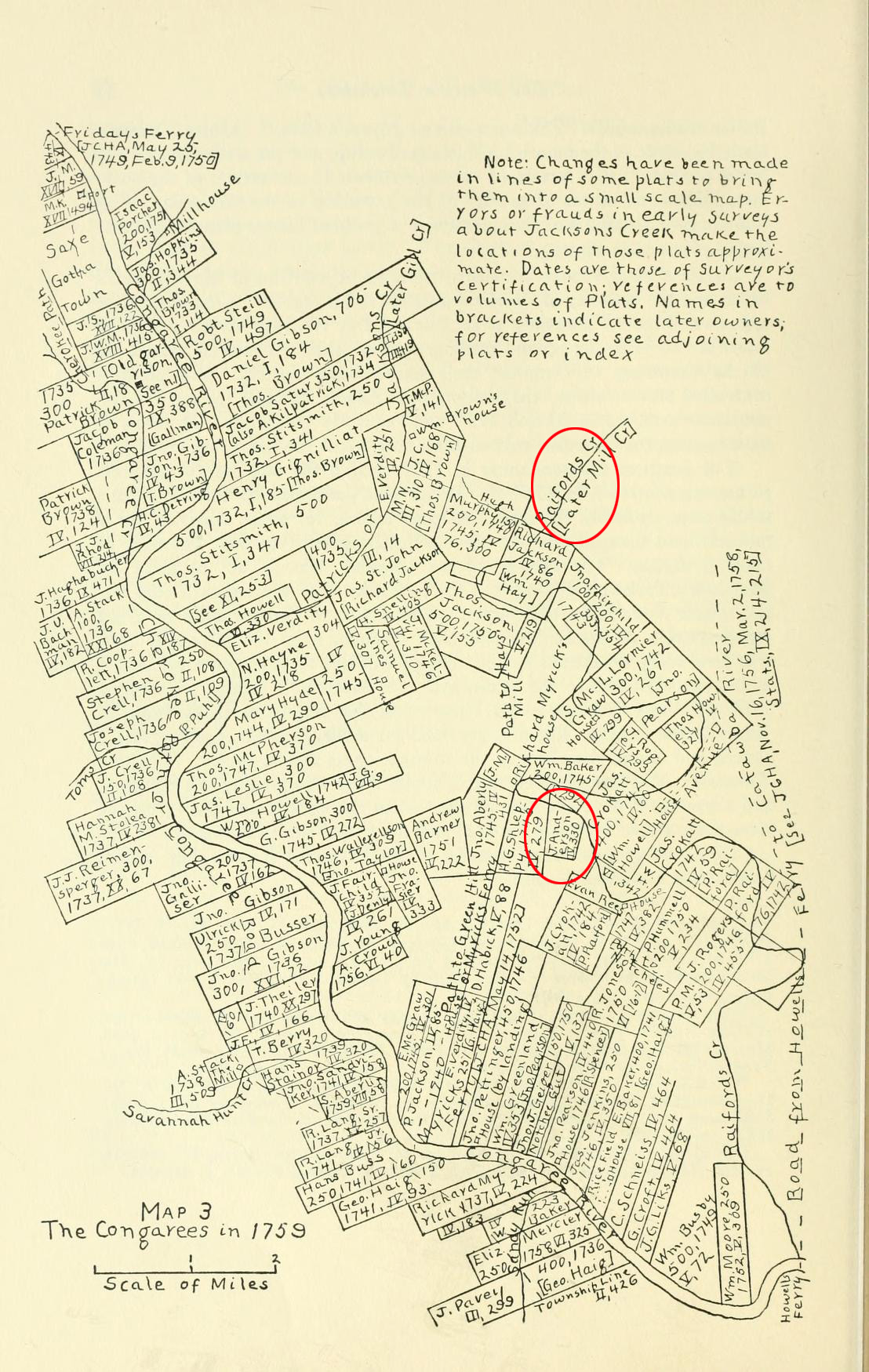
There is incontrovertible evidence (in my mind at least) that numerous folks from Occoneechee Neck, NC relocated to Saxe Gotha, SC in the 1720s to 1730s… roughly. These folks hailed from Isle of Wight/ Nansemond originally.
Robert Long, Philip Raiford, Joseph Joyner, Richard Jackson, others more from Prince George County Virginia…. see here http://andersonnc.com/?s=saxe+gotha
So… I went so far as to do an interlibrary loan and got a copy of the “Journals of the Indian Trade, South Carolina 1718 to 1720 something” and searched (read) the book looking for an ANDERSON…. nothing…. darn it.
Now I find this…
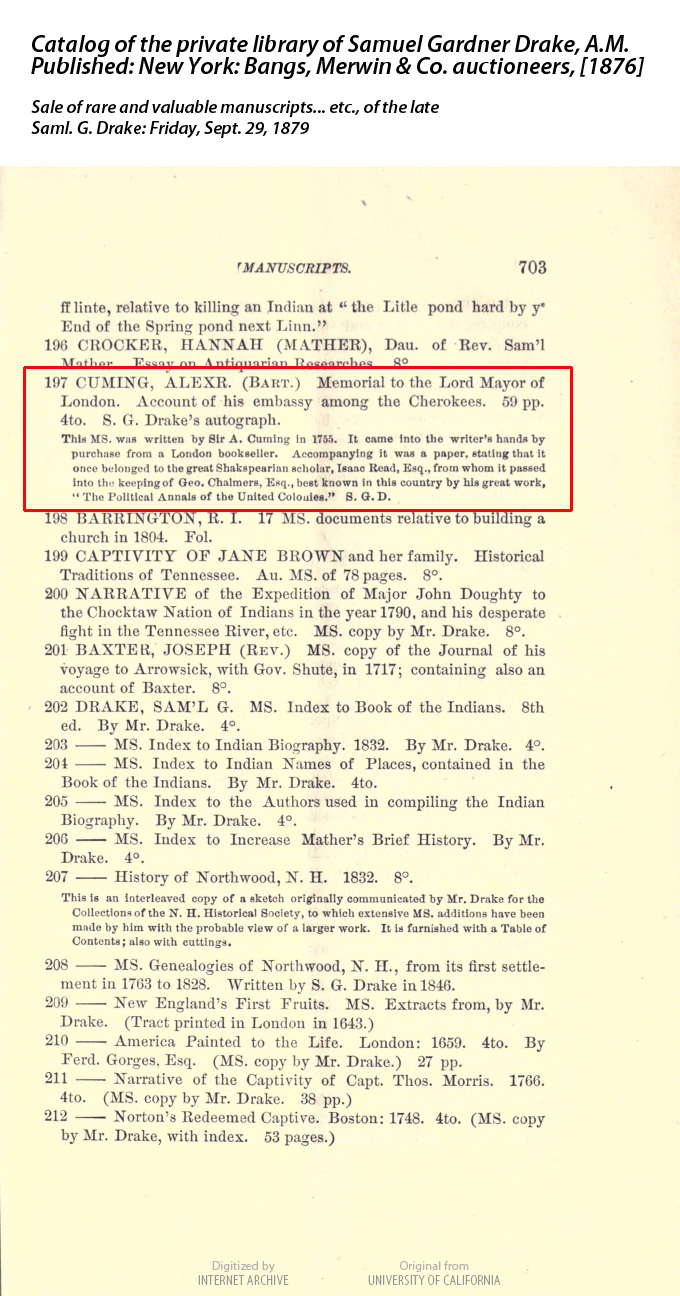
“Early history of Georgia, embracing the embassy of Sir Alexander Cuming to the country of the Cherokees, in the year 1730. A paper read in substance before the New-England Historic, Genealogical Society, February, 1872, by Samuel, G. Drake, M.A. ” … pause for a moment to consider that Mr. Drake was born 1798… he died shortly after this dissertation… and the guy had a VAST library of original documents… enough to make Thomas Jefferson slobber in jealousy if he had been earlier…
The principal object of this paper is to detail an early embassy to the country of the Cherokee Indians ; the chief authority for which is a MS. written by Sir Alexander Cuming, Bart., in the year 1755, the ambassador himself. This MS. came into the writer’s hands by purchase from a London bookseller. Accompanying it was a paper, stating that it once belonged to the great Shakesperian scholar, Isaac Read, Esq., from whom it passed into the keeping of George Chalmers, Esq….
…Sir Alexander Cuming was sent over as an ambassador in 1730; and from certain passages in his MS. it would seem that the affair was kept secret until his return, as no account is found of his preparation or departure upon the service, although arrangements had probably been made for it as early as 1728….
We do not find in our examination of documents any notice of the departure of Sir Alexander and his party ; but of his arrival in the Cherokee country and subsequent transactions, there is a minute account, which it is now proposed to sketch. That no record is found of the sailing of the embassy may be accounted for upon the hypothesis that it was secretly undertaken for apparent reasons then existing. News had reached England, that about the middle of March, 1729, an army of Carolinians, consisting of 100 white men and 100 Indians, had killed thirty-two Yomassee Indians and a fryar, burnt their town, and driven others into the castle at St. Augustine ; that an alliance was formed between the Creeks and Cherokees against the English, and that in this aspect of affairs the English traders did not dare to resume their business among them. This was the state of things when Sir Alexander Cuming arrived in ” Charles Town.” Nothing daunted, however, he left that place for the interior, on the 13th of March, 1730, and in ten days arrived at Keeakwee, 300 miles from Charleston. By the way he learned that the Cherokees were governed by seven Mother Towns : — These were Tannassie, Kettooah, Ustenary, Telliquo, Estootowie, Keyowee, and Noyohee. These towns had each their king, but at this time the kings of but three of the towns were alive, namely, those of Tannasee in the upper settlements ; of Kettooah in the middle ; and of Ustenary in the lower. Besides a king, or head man, each town had a head warrior.
On the 3d of April, Sir Alexander was at Telliquo with his company which consisted of Eleazar Wiggan, Ludovick Grant, Samuel Brown, William Cooper, Agnus Macpherson, Martin Kane, David Dowie, George Hunter, George Chicken, Lacklain Mackbain, Francis Baver, and Joseph Cooper, all British subjects. Here, at this time and place, Moytoy (of Telliquo) was chosen emperor over the whole Cherokee nation, and unlimited power was conferred upon him.
When Sir Alexander had arrived at a point about 100 miles from Charleston, he was informed by a Capt. Russel, that for two years the French had been endeavoring to seduce the Lower Cherokees to their interests ; that one Whitehead, a native of Paris, was the French agent. But here our documents take us a step back, in the detail of Sir Alexander’s journey in the Indian country. It was about five o’clock in the afternoon that he set out from Mr. James Kinloch’s plantation at New Gilmorton, being 23 miles from Charles Town. He was attended by Mr. George Chicken, besides Alexander Muckele, Aaron Cheesbrook, and Powel, pack-horse men ; but the pack-horse men having got drunk, and overturned the baggage, these were left behind, and Sir Alexander proceeded with only Mr. Chicken and Mr. George Hunter, and lay that night at Mr. Alexander Kinlock’s house at Wampee, 14 miles from his brother James’s. On the 14th the party reached Mr. Neilson’s, about 20 miles from their last named place. During this day’s march Sir Alexander employed much of it in searching for springs, ponds and minerals. The 15th they made 35 miles, and stopped at the house of Mr. Coxe. Here Sir Alexander met Mr. William Cooper, a bold man well skilled in the Cherokee language, who engaged to meet him on the next day, and attend him to the Cherokee mountains. March 16, they reached Capt. Russel’s before mentioned, but 10 miles from their stopping place ; having spent much time in search of curiosities. Among those discovered was a cave. They went into it. Mr. Hunter, Mr. Chicken and Mr. Coxe made marks to show that they had been there ; and Sir Alexander cut upon a stone on the left hand of it ” King George II., of Great Britain, wrote by S. A. C.” He also discovered some iron stone, which was one great end of his going in person to the mountains, not being able to depend upon the truth of any report he had heard in Carolina. Here his drunken pack-horse men came up. Two of those he discharged, and hired James Anderson in place of them. The 17th, more iron ore was discovered. On examining it Mr. Hunter found it yielded one third iron. Here Joseph Fairclough told Sir Alexander, privately, of a discovery he had made of copper, about 450 miles from the Catarba nation, and offered to conduct him to it, but Sir Alexander said his intent in going to the Cherokee mountains was more than answered by the discoveries already made, besides the getting roots for the bites of snakes : so he proceeded to Beaver Creek, and encamped under a tree some 18 miles from Capt. Russel’s.
March 18. After procuring several roots for the cure of the bites of snakes the party went on to the Congarees, where they again encamped under a tree, distance about 20 miles. Here happened something remarkable : Capt. How, a chief of the Catarba nation, by his manner towards Sir Alexander, whom Sir A. had made his friend, ordered his men to salute him with feathers, said they would dance round him all night, and would make him a present of all their skins ; but understanding that the dancing would disturb, instead of gratifying Sir Alexander, he ordered his men to desist, and withdrew and shot a turkey for his supper.
… and so the bizzare tale continues… read it here:
http://www20.us.archive.org/stream/earlyhistoryofge00drak#page/n9/mode/2up
WHAT? Seriously, I’m not making this up…. a near lunatic castletrash aristocrat by the name of Cuming travels from England in 1730, passes thru Saxe Gotha, SC, fires some drunken hands, hires a James Anderson, carries back 7 Cherokees to England, winds up in Debtor’s Prison in 1755 and writes a book which mentions “a James Anderson” … and the book is now lost.
So I tried tracking down the missing manuscript of the lunatic Sir Alexander Cuming just to check the good Mr. Drake’s facts… it appears to be eaten by the dog. But apparently Mr. Drake did have it in his possession……… and do you think he would make up something so insignificant as the James Anderson reference?
xxx
I trust my buddy Holmes and my buddyette Traci will find some amusement in this post…

xxx
For the seriously curious… I think Philip Raiford and James Anderson were “contemporaries”… meaning that they grew up as next door neighbors in Isle of Wight… each being born about 1695…
Andrew Ross and William Pitman (son in law)
I’ve moved this conundrum to a “Page” on the right….. see “Andrew Ross will”…
Abner Pitman… Marion Co. SC… wife Martha?
I found these entries in SC Probate Records, Marion Co., 1800-1825… no index and a tedious search for Pitmans…
Martha Pitman…. widow of Abner?

—

Is this the Turner Bryan?
“Abstracts of Wills, Edgecombe County North Carolina, 1733-1856”, by Ruth
Smith Williams & Margaret Glenn Griffin
pg. 61 Edgecombe Co. NC dated 12 August 1797, probated Aug 1797
William Bryan: names wife Lizanar and children Turner Bryan, Bat Bryan,
Patty Bryan, Polly Bryan, Canadah Bryan, Barbary Bryan

—

Charity Pitman… sister of Abner?

Sarah Pitman

—
A Malachi Murphy was associated with Abner in Edgecombe… is this him?

A “James Harrell” is noted in one of the entries above…
Series: S108093
Reel: 0017
Frame: 00718
Item: 000
Date: 6/4/1829
Description: HARRELL, JAMES OF MARION DISTRICT, WILL TYPESCRIPT (MSS WILL: BOOK 1, PAGE 167; ESTATE PACKET: ROLL 371) (1 FRAME).
Names indexed: HARRELL, JAMES; HARRELL, MARY H.; HARRELL, MATTHEW W.; PITMAN, CHARITY; PITMAN, SARAH
Locations: MARION DISTRICT
Document type: WILL (TYPESCRIPT)
http://www.archivesindex.sc.gov/onlinearchives/RecordDetail.aspx?RecordId=298204
notes…
——————
source: http://www.martygrant.com/genealogy/familydata/aqwn908.htm
Charity Pitman
CENSUS:1850 Marion Dist., SC # 881/885
Ithamer Gaddy 85 Farmer $500 Marion
Charity 74;
NAMED-PROBATE ROLL # 321 Marion Co., SC Ithamar Gaddy 1851
Will dated 20 Sep 1850
grave stones form my wife Charity and William Gaddy my son decd.
Gr-Ch John J. Gaddy, Levi Gaddy, Israel Gaddy, Mary Gaddy, Samuel Gaddy, Joseph Gaddy, Charles Gaddy, Sarah Gaddy and Adeline Gaddy, all the children of my son William Gaddy, decd except Elizabeth Grantham wife of Elias Grantham.
Gr-children John, Ann, Civil and Catherine Grantham children of my dau Elizabeth Grantham, decd.
my sons James, Hardy, and Allen Gaddy.
Dau Nancy Hays
son Silas Gaddy
dau Mary Stackhouse
no proven date, appraisal dated 16 Jan 1851
…;
REFERENCE: A History of Marion County, South Carolina From Its Earliest Times to the Present, 1901, by W. W. Sellers, Esq., of the Marion Bar. 1902. pp. 176-178
Gaddy.—Another family in Hillsboro, is the Gaddy family. Old man Ithamer Gaddy was the first known ; his wife, Charity, was a Miss Pitman, sister of old man Hardy Pitman, who seventy-five years ago lived near by, and was a prominent citizen ; the name Pitman is not found in the county. Old man Ithamer Gaddy was a most excellent man, quiet and inoffensive, a Christian gentleman ; he raised a large family, five sons and two daughters; the sons were William, James, Hardy, Allen and Silas; the daughters were Elizabeth and Mary (Polly, as she was called). ;
Amy Pitman will and children…. http://sciway3.net/proctor/marion/wills/PitmanAmy.html
Pitman stuff…
1738 (p. 48) 21 Mar 1738 . . . Account current of Estate of Elizabeth Champion, decd., by Charles Champion, administrator, lists “Col. Allen for Probation of my father’s will”, “for my mother”, Capt. Ruffin, Benjamin Champion, Benjamin Bell, John Wall, Sr., Absolan Atkinson, Mary Champion, Joseph King, John Bynum, Charles Kea, Nicholas Valentine, Samuel Lancaster, Jr., Lemuel Hargrove, Jr., Augustus Hargove, Anselm Baily, Henry Atkins, William Lancaster, Lawrence Lancaster, William Nettle, William Coker, John Coker, William George, Robert Mercer, Robert Lancaster, Jr., Thomas Lyles, WILLIAM PITMAN, James Stringfield, Benjamin Baily, BENJAMIN PITMAN, Richard Blow, Elizabeth Champion, John Waller, Jr., Thomas Riggon, William Barrow, Thomas Hardyman, Francis Riggon, William Davidson, JOSEPH PITMAN, Thomas Holiman, Jr., William Little, Thomas Bell, Samuel Person, Allen Warrin, Jr., James Bennit, Jr., John Judkins, Robert Landcaster (sic), James Washington and John Clarke (Surry Co VA).
from post of Guy Baker… http://genforum.genealogy.com/pitman/messages/1565.html
———————-
I think William Pitman was the father of Benjamin Pitman and Joseph Pitman….(I’m theorizing here so work with me)… this older William was likely the brother of Thomas Pitman of Meherrin River who died 1730. Joseph “the Quaker” was the son of this Thomas of Meherrin. Joseph was born 1724.
Benjamin and Joseph were Quakers in Surry Co, VA. They relocated to Edgecombe. Note their death dates… Benjamin 1755, Joseph 1763.
The younger generation Joseph b.1724 was only 6 years old when his father died. I theorize that this young Joseph was raised by his uncle Benjamin or Joseph Sr….
This is how Joseph b1724 became a Quaker. I don’t think any of the other sons of Thomas d1730 were Quakers.
Joseph “the Quaker” dies intestate in 1782… but he leaves that deed of 1782 which I think in essence is a will…
Run all your questions around that scenario and see if it fits…
Finally, the Joseph Pitman who acquired the property of Elizabeth Pitman in 1761 was the son of Robert Pitman, another son of Thomas d1730. He basically had nothing to do with the Quaker Pitmans.
And… I’ll attempt to be serious… uh huh…. that Jan 1766 Court Minutes entry has stopped every serious researcher dead in their tracks… again, I think it was just a clerical error because without it Logic prevails and this puzzle is actually really simple.
Fence posts and arguing therewith…
So I’m hooting, hollering, strutting, patting my own back and generally dancing around because in my mind I had finally solved the case of “the Quaker” Joseph Pitman. The one that perplexed Hugh B. Johnston and has been a thorn in my side for years. So whilst I’m celebrating, my buddy David throws a dead cat and trips up my dancing. I had crafted my theory so tightly that not even light could get in… much less the theory be wrong. … I’m referring to the Quaker Pitmans of a couple “Posts” back…
Like I say… my buddy David throws this dead cat in my way…
from the Edgecombe Court Minutes…
[117] Jan1766
Anne PITMAN Guardian of Jethro Anne & Chloe PITMAN Orphans of Joseph PITMAN deced.
exhibited on Oath accts. of her Guardianship which were allow’d &c.
Joseph PITMAN Guardian of Thomas PITMAN Orphan of Joseph PITMAN deced. exhibited
his acct. by his Afirmation which was allow’d &c.
Thomas Pitman CANNOT BE “Orphan of Joseph Pitman deced.” Because Joseph Pitman WAS NOT DECEASED because he was both the father and guardian of Thomas Pitman .
So I’m saying this historical record is WRONG>
Take your pick:
The Court Scribe was drunk or hungover.
The Court Scribe was stupid and Lazy.
The Court Scribe was daydreaming and not paying attention.
The Court Scribe was “messing” with any future genealogists and the bastard knew it.
I can’t find that Jan. 1766 court document but I have found a pile of the Guardian documents and NOWHERE does in mention
Thomas Pitman “Orphan of Joseph Pitman”… ALL of the Ann Pitman documents mention those children as “Orphans of Joseph Pitman” which is why I think a inattentive scribe simply wrote down an error.
Thomas Pitman was always referred to as “Heir” or “Legatee” of John Gay Junr… never as “orphan of Joseph Pitman”.


